Marquee HVAC Tonnage Sizing: Square Footage & Guest Heat Load Engineering Matrix
Sizing commercial climate control for large clear-span event marquees requires accounting for rapid occupant surges, high envelope solar heat gain through PVC membranes, and extreme summer ambient temperatures exceeding 45°C. This technical dossier details heat balance governing equations, sensible heat ratios, and empirical cooling tonnage benchmarks across Punjab, Sindh, and Islamabad.
1. Governing Heat Balance Equations & Sensible Heat Ratios
Thermal engineering in temporary and semi-permanent structures relies on the classical steady-state heat balance equation: Total Cooling Load Q_total = Q_envelope + Q_solar + Q_occupants + Q_lighting + Q_ventilation + Q_equipment. Unlike standard masonry commercial buildings where thermal mass dampens diurnal fluctuations, a polyvinyl chloride (PVC) coated polyester fabric membrane has near-zero thermal capacitance. Solar radiation striking the roof outer surface instantly conducts through the 0.8mm to 1.2mm fabric layer into the conditioned occupied zone.
The sensible heat ratio (SHR = Q_sensible / Q_total) in a high-density wedding marquee typically ranges from 0.75 to 0.82 during peak dinner service. Sensible cooling requirements are governed by Q_sensible = 1.08 * CFM * (T_indoor - T_supply), where CFM represents the volumetric airflow rate, and Delta T represents the supply-to-room temperature differential. Maintaining an indoor design condition of 22°C (71.6°F) Dry Bulb and 50% Relative Humidity against a 46°C ambient environment demands supply air delivery temperatures between 11.5°C and 13.0°C across the primary evaporator faces.
Latent cooling loads Q_latent = 4840 * CFM * (W_indoor - W_supply), where W represents the humidity ratio in pounds of moisture per pound of dry air, escalate rapidly during July and August monsoon periods in Lahore and Rawalpindi. Failure to maintain sufficient coil depth (minimum 4 to 6 rows) results in elevated room relative humidity (>70% RH), causing fabric sweating, ceiling condensation dripping, and severe occupant discomfort regardless of dry-bulb air temperature.
GOVERNING PSYCHROMETRIC FORMULA:
Q_total (BTU/hr) = 4.5 * CFM * Delta_h
Where Delta_h = Enthalpy difference across cooling coil (BTU/lb dry air).
For 48°C ambient entering air (h = 42.5 BTU/lb) down to 12.5°C saturation (h = 17.2 BTU/lb),
Delta_h = 25.3 BTU/lb. Required CFM per ton = 400 CFM/TR.
2. Dynamic Occupant Sensible & Latent Heat Dissipation Sizing
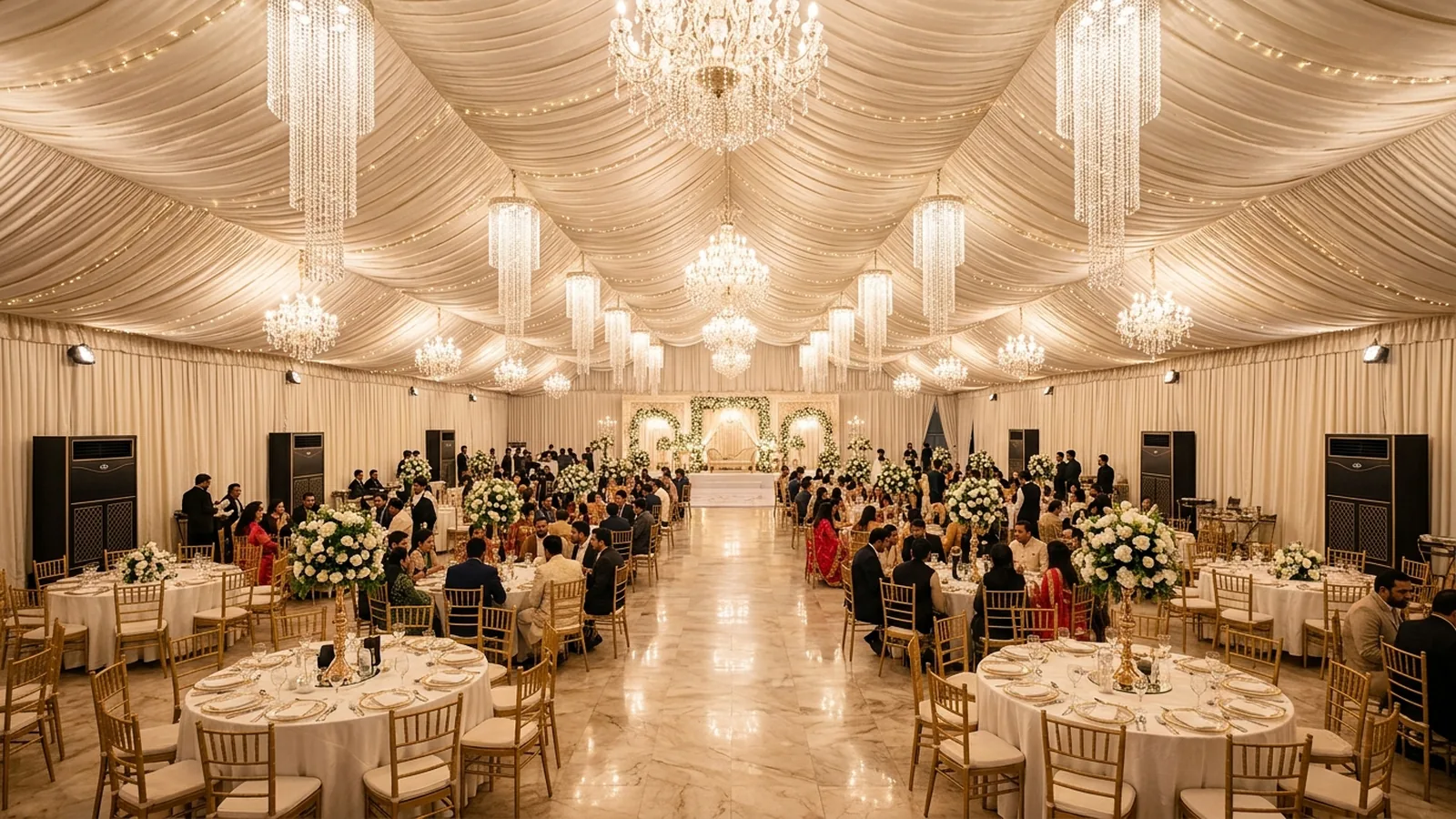
A human body at rest in a moderate environment generates approximately 400 BTU/hr of metabolic heat. However, in a Pakistani wedding hall or gala banquet, metabolic rates escalate significantly due to formal attire (heavy embroidered sherwanis, formal suits, and silk apparel), walking between food buffet stations, dining, and live musical entertainment.
Engineering load calculations must allocate 450 to 550 BTU/hr per seated guest (approximately 280 BTU/hr sensible and 220 BTU/hr latent). During active movement, stage photo sessions, or dance festivities, occupant heat emission spikes to 650–750 BTU/hr per person. For a 1,000-guest luxury marquee, human occupants alone inject 550,000 BTU/hr of thermal energy—equivalent to roughly 45.8 Tons of Refrigeration (TR) of instantaneous internal load that must be continuously absorbed by the HVAC plant.
In addition to metabolic heat, high-lux photography and cinematic halogen stage lighting rigs contribute massive sensible heat. Contemporary LED wash fixtures generate approximately 3.41 BTU/hr per Watt of electrical power draw, whereas legacy tungsten halogen spotlights emit up to 90% of their electrical energy as direct radiant heat into the space. A typical wedding stage truss consuming 15 kW of lighting adds another 51,150 BTU/hr (4.26 TR) of continuous sensible load.
| Guest Count | Occupant Load (TR) | Lighting Load (TR) | Ventilation Load (TR) | Envelope/Solar (TR) | Total Recommended Plant |
|---|---|---|---|---|---|
| 300 Guests | 13.8 TR | 3.0 TR | 8.5 TR | 14.7 TR | 40 TR (2x 20T Units) |
| 500 Guests | 22.9 TR | 4.5 TR | 14.2 TR | 24.4 TR | 68 TR (3x 20T + 1x 10T) |
| 800 Guests | 36.7 TR | 6.5 TR | 22.8 TR | 38.0 TR | 104 TR (5x 20T + 1x 10T) |
| 1,200 Guests | 55.0 TR | 9.0 TR | 34.2 TR | 53.8 TR | 152 TR (7x 20T + 1x 12T) |
| 2,000 Guests | 91.7 TR | 14.0 TR | 57.0 TR | 89.3 TR | 252 TR (12x 20T + 1x 12T) |
3. Tensile PVC vs Insulated Sandwich Panel Envelope U-Values
The thermal transmittance (U-value) of the marquee envelope dictates the baseline static conduction load. Single-layer translucent or blackout PVC membranes (850 g/m² Blockout) exhibit an overall heat transfer coefficient (U-value) between 5.6 W/m²K and 6.2 W/m²K (0.98 to 1.09 BTU/hr·ft²·°F). With solar radiation absorption heating the outer fabric surface up to 68°C under direct summer sunlight, heat transfer through the roof is exceptionally high.
By comparison, contemporary German-spec dual-skin PVC roofs with an internal pressurized thermal air pocket or 50mm glass-wool quilt insulation reduce the overall U-value to approximately 2.8 W/m²K to 3.2 W/m²K, slashing roof transmission heat gain by over 45%. When venues invest in rigid 50mm–75mm Polyurethane Foam (PUF) or Polyisocyanurate (PIR) insulated sidewall sandwich panels (U-value = 0.28 to 0.38 W/m²K), wall transmission losses drop by more than 80% compared to standard perimeter curtains.
Floor conduction must also be evaluated. Bare concrete slabs or asphalt bases absorb extensive ground heat in hot seasons. Utilizing elevated steel-frame cassette flooring with plywood decking and dense underlay carpeting introduces an effective thermal resistance layer (R-value = 1.8 to 2.4 ft²·°F·hr/BTU), eliminating thermal bleed from sub-grade ground temperatures.
4. Empirical Sizing Rule-of-Thumb vs Psychrometric Load Calculation
A pervasive failure in the Pakistani event cooling sector is relying on domestic residential HVAC sizing ratios (such as 1 Ton per 150–200 sq ft). For clear-span temporary marquees, applying domestic metrics leads to catastrophic cooling failure during mid-summer evening weddings.
Empirical engineering data across 150+ monitored commercial marquee installations establishes the following benchmark metrics for Pakistan's climatic conditions: For single-skin PVC marquee structures, the sizing baseline is 75 to 90 sq ft per Ton of cooling (133 to 160 BTU/hr per sq ft). For dual-skin insulated PVC marquees, sizing improves to 100 to 120 sq ft per Ton (100 to 120 BTU/hr per sq ft). For fully insulated PEB sandwich panel banquet halls, sizing reaches 130 to 150 sq ft per Ton.
When cross-referencing floor area against occupant headcount, the rule of thumb requires 1 Ton of cooling for every 8 to 10 guests in single-skin fabric marquees, and 1 Ton per 12 to 14 guests in insulated structures. Sizing equipment on both metrics (area and headcount) and selecting the higher capacity value ensures that unexpected peak guest arrivals never overwhelm the evaporator coils.
5. Safety Margins & Ambient De-Rating for 45°C+ Subcontinent Summers
Refrigeration compressor capacity is internationally rated under standard AHRI conditions (35°C outdoor dry bulb, 26.7°C indoor dry bulb, 19.4°C indoor wet bulb). In Lahore, Multan, Faisalabad, and Sukkur, daytime summer ambient temperatures frequently hit 46°C to 48°C, with condensing coil entering air temperatures reaching 50°C due to radiant ground reflections.
At 48°C ambient, standard T1-rated compressors experience severe suction gas superheat, high compression ratios, and discharge pressure spikes that trigger high-pressure safety cutoffs. Operating at 48°C de-rates nominal refrigeration capacity by 14% to 18%, while compressor electrical power input increases by 12% to 16%. Consequently, a nominal 20-ton cabinet delivers only 16.6 to 17.2 tons of actual net cooling capacity under peak heatwave conditions.
Fusion Developers counteracts ambient de-rating by engineering T3 tropicalized oversized condenser coils with gold-fin epoxy coating and subcooling circuits, alongside a mandatory 15% safety factor applied to all total load calculations. This guarantees that internal hall setpoints of 22°C are reliably maintained even when the mercury outdoors peaks at 49°C.
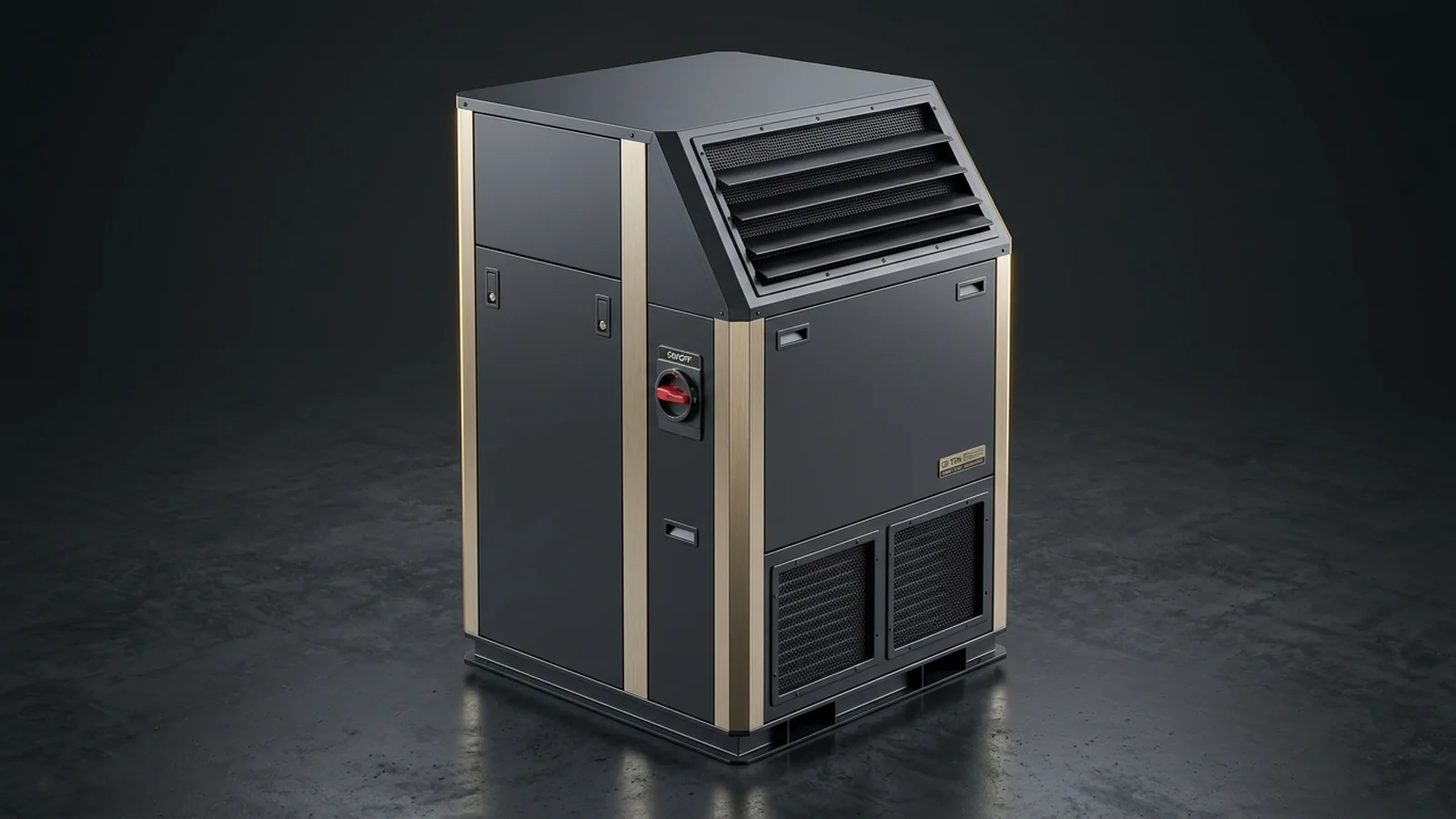
20 Ton Commercial Floor-Standing HVAC Cabinet (FD-HVAC-020)
Dual-circuit Copeland Scroll architecture engineered specifically for marquee deployments, delivering balanced sensible heat ratio (SHR 0.82) and 8,000 CFM high-throw air volume.
Model Your Venue & Estimate HVAC Tonnage in 3D
Use the Fusion Developers interactive 3D Structure & Marquee Configurator to dimension spans from 15m to 60m, simulate guest heat loads, and compute instant multi-currency Bill of Quantities (BOQ).
Related Commercial HVAC Engineering Dossiers
Thermal Pull-Down in 48°C Ambient Heat
Pre-cooling curves and high-pressure cutoff protection.
Generator Sizing & Electrical Load Multi-Cabinet
Starting kVA and step-sequencing generator calculations.
Lahore Luxury Marquee Cooling Engineering
Microclimate solutions for Bedian and Raiwind Road venues.
Engineering & Procurement Inquiries
Q: How many square feet per ton of cooling are required in a wedding marquee in Pakistan?
For single-skin PVC fabric marquees under 42°C+ summer heat in Pakistan, the engineering benchmark is 75 to 90 sq ft per ton of refrigeration (TR). In well-insulated dual-skin or sandwich panel structures, this metric improves to 110 to 140 sq ft per ton.
Q: How much thermal heat load does an individual wedding guest generate?
An average seated banquet guest dissipates approximately 450 to 550 BTU/hr (sensible heat plus latent moisture emission). For active movement, dancing, or crowded buffet corridors, load calculations increase to 650–750 BTU/hr per person.
Q: Why are commercial floor-standing cabinets preferred over split AC units in marquees?
Commercial floor-standing units deliver high airflow volume (4,000 to 9,600 CFM) with high-throw centrifugal blowers that push conditioned air up to 35 meters across clear-span halls without requiring ceiling suspension from marquee fabric trusses, providing rapid 90-minute pull-down.
Q: How does outdoor ambient heat affect HVAC cooling capacity in Punjab summers?
At 48°C ambient temperature, standard commercial compressors de-rate by approximately 15% to 18% in cooling capacity while drawing 14% more electrical current. Fusion Developers uses oversized T3 tropicalized condenser coils to maintain full rated capacity up to 52°C.
Request Stamped Psychrometric Calculations or Tender BOQ
Our senior mechanical HVAC engineers provide certified thermal heat balance assessments, electrical single-line schematics, and factory-direct equipment supply across Pakistan.
Consult Chief Engineer on WhatsApp (+92 332 2227426)