Thermal Pull-Down Dynamics: Engineering Rapid Cooling Ramp-Down in 48°C Ambient Heat
During intense summer heatwaves across Central and South Punjab, unconditioned marquee interiors can reach thermal soak temperatures exceeding 54°C (129°F) prior to commissioning. Achieving an operational setpoint of 22°C within a strict 90 to 120-minute window requires specialized thermodynamic engineering, oversized heat exchangers, and intelligent multi-stage compressor ramping.
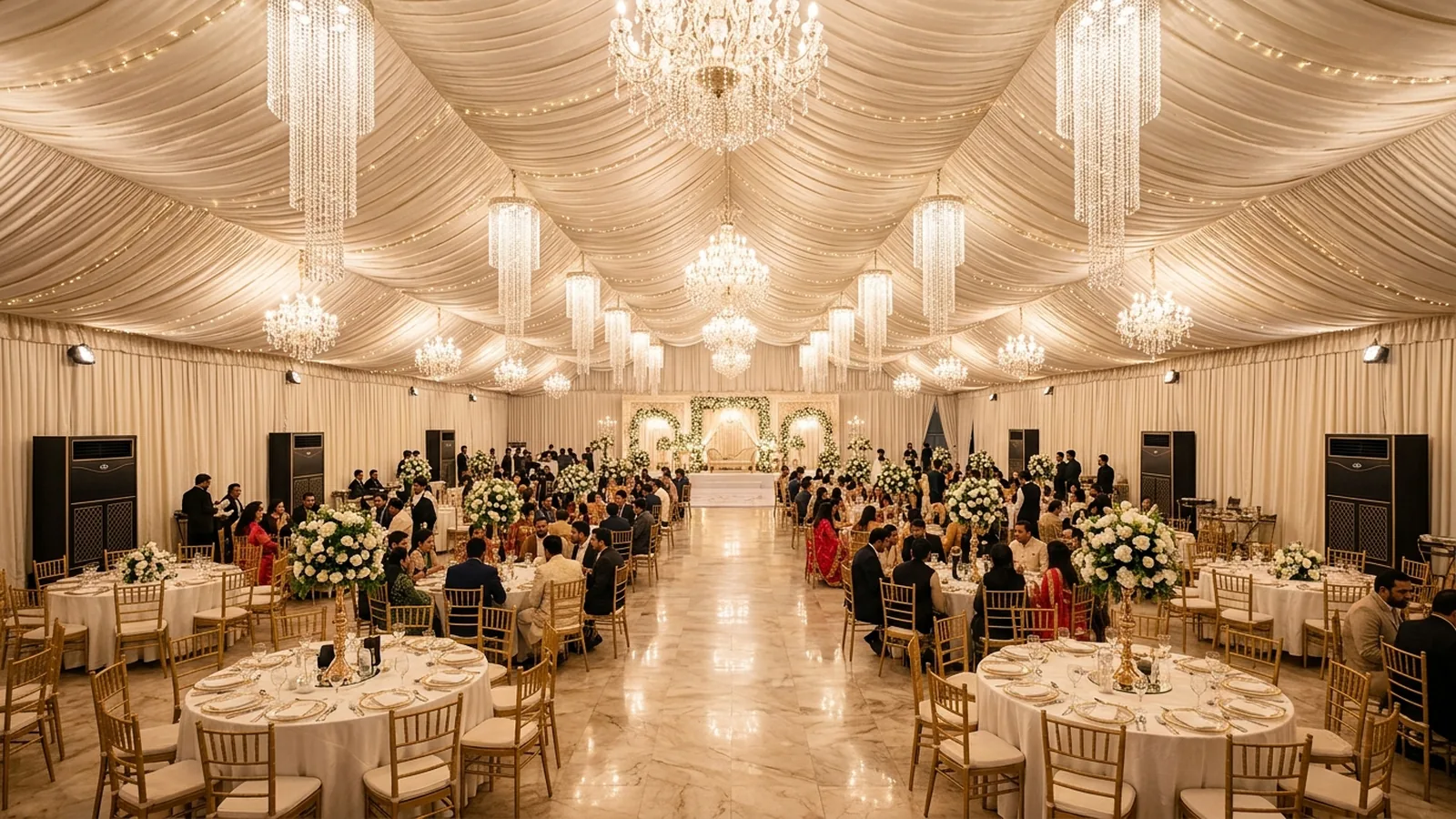
1. Transient Thermal Pull-Down Dynamics & Heat Storage Dissipation
Thermal pull-down is an inherently unsteady, transient thermodynamic process governed by Newton's law of cooling and thermal mass enthalpy dissipation: m * C_p * (dT/dt) = Q_cooling(t) - Q_envelope(t) - Q_internal(t). When an enclosed structure has soaked in summer sunlight from 10:00 AM to 5:00 PM, substantial thermal energy is stored in the floor substrate, structural aluminum framework, furniture, carpeting, and the hot air volume itself.
In a 15,000 sq ft marquee with an average ceiling height of 6.0 meters, the enclosed air volume comprises approximately 90,000 m³ (3,178,000 cubic feet). Air density at 50°C is 1.09 kg/m³, with a specific heat capacity C_p = 1.005 kJ/kg·K. Lowering the air mass alone from 52°C to 22°C requires absorbing approximately 2.96 million BTU of sensible enthalpy, excluding the substantial thermal capacitance of 1,200 upholstered banquet chairs, dining tables, stage carpentry, and carpet padding.
If the HVAC plant is merely sized for steady-state holding capacity (Q_holding), the pull-down ramp rate dT/dt is painfully slow, taking over 4 to 5 hours to reach target conditions. Sizing must incorporate a dedicated 'pull-down multiplier' (P_factor = 1.25 to 1.35) to provide the surplus cooling capacity needed to force rapid thermal ramp-down within the critical 90-minute pre-event commissioning window.
TRANSIENT PULL-DOWN CAPACITY FORMULA:
Q_required = Q_holding + (M_thermal * C_p * Delta_T) / t_pulldown
Where M_thermal is effective structural thermal mass (lbs),
C_p is specific heat (0.24 BTU/lb·°F), and t_pulldown is target time (hours).
Targeting a 1.5-hour pull-down requires +28% surplus refrigeration capacity above steady-state load.
2. Solar Radiation Heat Gain on PVC Envelopes (Sol-Air Temperature Physics)
Direct solar radiation intensity in Pakistan during June and July reaches up to 1,050 W/m² (333 BTU/hr·ft²). The thermal driving force across the roof envelope is not the simple outdoor dry-bulb temperature, but the effective Sol-Air Temperature: T_sol-air = T_ambient + (alpha * I_solar) / h_outdoor - (epsilon * Delta_R) / h_outdoor.
For a white PVC membrane with a solar absorptivity alpha = 0.28 and outdoor surface heat transfer coefficient h_outdoor = 17 W/m²K, when ambient dry bulb is 47°C, the sol-air temperature peaks at approximately 64.3°C (147.7°F). In un-insulated marquees where dust and atmospheric pollutants have deposited on the fabric over weeks of operation, absorptivity alpha can increase to 0.45, pushing sol-air temperatures above 74°C.
This massive temperature gradient drives radiant and conductive heat flux across the membrane directly into the upper ceiling zone of the marquee. As hot air naturally rises and stratifies below the roof ridge, it creates a superheated thermal reservoir that continuously re-radiates downward onto guests unless scavenged by high-velocity discharge air curtains.
3. High-Discharge Pressure Mitigation up to 52°C Ambient
As ambient temperature rises toward 48°C and beyond, conventional refrigeration condensers experience soaring condensing pressures. For R410A refrigerant, normal condensing temperature at 35°C ambient is approximately 45°C (saturation pressure 26.2 bar / 380 psig). At 48°C ambient, condensing temperatures surge to 58°C to 62°C, pushing discharge pressures above 39.5 bar (573 psig)—perilously close to the standard 42 bar (610 psig) high-pressure safety trip limit.
When a compressor trips on high pressure, the refrigeration circuit locks out. In a live event setting, restarting locked compressors while the space rapidly reheats causes immense reputational damage. High-ambient engineering requires three vital hardware safeguards: First, condenser coil surface areas must be expanded by 30% to 45% compared to standard T1 commercial units.
Second, condenser fan aerodynamic profiles must utilize high-volume sickle-blade axial fans driven by high-temperature Class F insulated motors capable of delivering >12,000 CFM of outdoor coil heat rejection per 20 tons of refrigeration. Third, liquid subcooling coils must be integrated into the lower condenser passes to cool liquid refrigerant 5°C to 8°C below condensing saturation, suppressing flash gas formation before the thermostatic expansion valve.
4. 3-Phase Pre-Cooling Operational Protocol for Venue Operators
To maximize energy efficiency while ensuring flawless banquet thermal comfort, venue operators must adhere to a standardized 3-Phase Pre-Cooling Protocol developed by Fusion Developers engineering teams.
Phase 1: Deep Thermal Purge (Event T-minus 180 to 120 minutes). Two hours before guest arrival, with the marquee fully enclosed, all HVAC units are engaged at 100% full compressor capacity with blower fans running at maximum RPM. The indoor setpoint is programmed to 18°C (64.4°F). This phase aggressively pulls heat out of the furniture mass, carpet underlay, and structural steel trusses while the hall is completely unoccupied.
Phase 2: Thermal Equilibrium Stabilization (T-minus 60 minutes to T-zero). As indoor dry-bulb temperature stabilizes at 19°C–20°C, the thermal mass of the floor and furniture acts as a 'cold thermal battery.' Evaporator coils operate with established deep refrigerant superheat, maximizing latent moisture extraction.
Phase 3: Occupant Surge Modulation (Event T-zero to T-plus 180 minutes). As 800 to 1,500 guests enter the venue within a concentrated 45-minute arrival window, the massive influx of body heat is immediately buffered by the pre-cooled 19°C structural mass, preventing the common 4°C–6°C temperature spike observed in poorly pre-cooled halls.
5. Subcooler Refrigerant Circuit Optimization & TXV Superheat Tuning
In high-ambient refrigeration cycles, liquid refrigerant leaving the condenser must not enter the liquid line near saturation. If pressure drops across the liquid line filter-drier or solenoid valve, saturated liquid flashes into vapor bubbles ('flash gas'), drastically choking thermostatic expansion valve (TXV) mass flow capacity and causing evaporator starvation.
Fusion Developers cabinets incorporate dedicated liquid subcooling circuits integrated directly into the lowest 4 passes of the condenser coil. By rejecting heat into the coolest entering ambient air stream, liquid refrigerant is subcooled by 6.0°C to 8.5°C (11°F to 15°F). This guarantees a solid column of liquid at the TXV inlet, increasing overall refrigeration cycle coefficient of performance (COP) by 8% to 11%.
Furthermore, TXV superheat is calibrated specifically for T3 tropical conditions. Instead of a tight 4K superheat that risks liquid floodback during rapid outdoor condenser temperature swings, expansion valves are tuned to a stable 7.0K to 8.5K superheat with balanced-port bi-directional power heads that maintain stable evaporator feeding across condensing pressures from 20 to 40 bar.
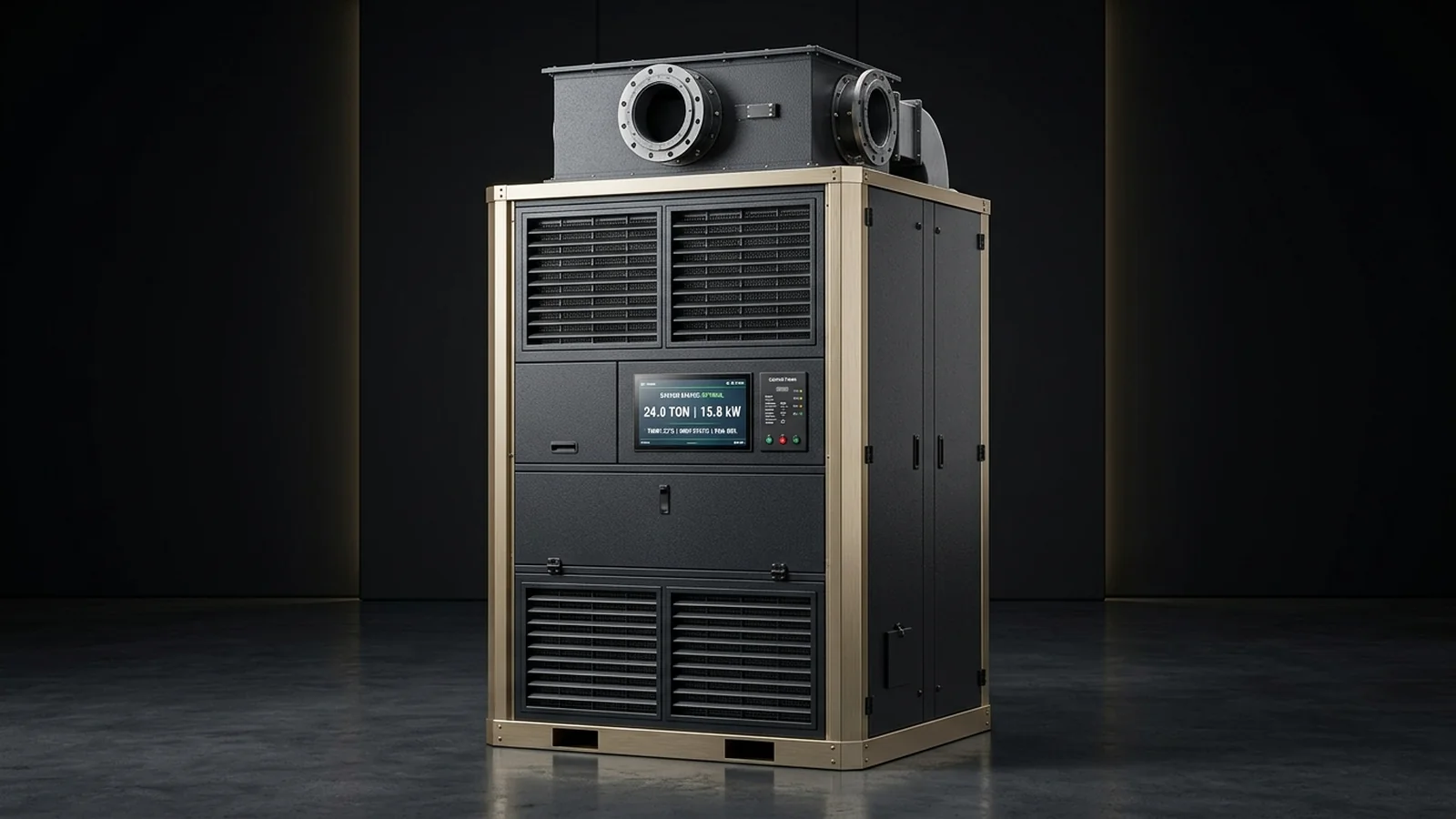
24 Ton High-Static Commercial HVAC Cabinet (FD-HVAC-024)
T3 tropicalized monster unit built for 52°C extreme ambient operation, featuring dual oversized condenser heat exchangers, 350 Pa static pressure blowers, and rapid thermal pull-down performance.
Model Your Venue & Estimate HVAC Tonnage in 3D
Use the Fusion Developers interactive 3D Structure & Marquee Configurator to dimension spans from 15m to 60m, simulate guest heat loads, and compute instant multi-currency Bill of Quantities (BOQ).
Related Commercial HVAC Engineering Dossiers
Marquee Sizing: Tonnage per Sq Ft & Guest Count
Calculate total sensible and latent heat loads.
Multan & South Punjab Marquee Cooling Guide
Combat 50°C summer heat in South Punjab.
Condensation & Humidity Prevention in PVC Marquees
Prevent fabric sweating during monsoon heat.
Engineering & Procurement Inquiries
Q: What is the recommended pre-cooling time for a 1,000-person marquee in 46°C heat?
A minimum of 120 minutes of full-capacity pre-cooling is required before guest arrival. This pulls stored heat out of the floor, carpeting, furniture, and structural framing, preventing sudden temperature spikes when occupants arrive.
Q: Why do standard commercial AC units trip on high pressure during hot Pakistani afternoons?
Standard units are rated for 35°C ambient (T1 climate). At 48°C ambient, discharge pressures exceed 580 psig, tripping safety switches. Tropicalized T3 units have 35% larger condenser coils and high-flow fans to keep pressures below 480 psig up to 52°C.
Q: What is Sol-Air temperature and how does it affect tent cooling?
Sol-Air temperature combines ambient air temperature with solar radiation absorptivity. On a white marquee roof in 47°C ambient, solar radiation can drive the outer fabric temperature up to 65°C–70°C, dramatically accelerating heat conduction into the space.
Q: How does liquid subcooling improve cooling performance in extreme heat?
Subcooling cools liquid refrigerant 6°C to 8°C below condensing saturation before it reaches the expansion valve. This eliminates vapor flash gas, ensures 100% liquid flow into the evaporator, and improves overall system cooling efficiency by 8% to 11%.
Request Stamped Psychrometric Calculations or Tender BOQ
Our senior mechanical HVAC engineers provide certified thermal heat balance assessments, electrical single-line schematics, and factory-direct equipment supply across Pakistan.
Consult Chief Engineer on WhatsApp (+92 332 2227426)