Diesel Generator Sizing & Electrical Load Architecture for Multi-Cabinet HVAC Deployments
Commercial HVAC plants represent inductive electrical loads with severe locked rotor inrush currents (LRA) reaching 4 to 6 times nominal running load amps (RLA). In temporary event venues and off-grid facilities reliant on diesel generators, undersized gensets suffer alternator voltage collapse, frequency dips, and breaker tripping during compressor startup.
1. Motor Inrush Amps (LRA) vs Running Load Amps (RLA) Dynamics
An induction motor at rest exhibits near-zero rotor back-electromotive force (back-EMF). At the instant contactors close across 380V/415V 3-phase lines, current draw is constrained solely by stator winding impedance. This results in Locked Rotor Amperage (LRA) lasting approximately 120 to 250 milliseconds until the rotor accelerates past 80% synchronous speed.
For a commercial 20-ton cabinet powered by two Copeland scroll compressors (ZP120KCE), the Running Load Amperage (RLA) per compressor is approximately 22.5 Amps at 400V 3-phase (total cabinet running load = 45A compressors + 6.5A blower + 5.0A condenser fans = 56.5A continuous full load). However, the Locked Rotor Amps (LRA) for each compressor reaches 118 Amps.
If both compressors across multiple cabinets are permitted to start simultaneously, the aggregate inrush spike can demand over 600% of the nominal generator alternator capacity. This massive surge causes instantaneous generator voltage dips (>20%), triggering electronic under-voltage relays, dimming venue lighting, and stalling adjacent equipment.
STARTING KVA CALCULATION FORMULA:
Starting kVA = (V_line * I_LRA * sqrt(3)) / 1000
For one 10-ton scroll compressor (LRA = 118A at 400V):
Starting kVA = (400 * 118 * 1.732) / 1000 = 81.7 kVA.
Without staggered staging, starting two 20T cabinets simultaneously requires >280 kVA of surge capacity!
2. Staggered Step-Starting Sequencer Integration (PLC Timer Logic)
To prevent catastrophic generator inrush overloads, multi-cabinet HVAC networks must deploy automated Step-Starting Sequencing logic. Rather than engaging all refrigeration circuits in a single uncontrolled surge, microprocessors coordinate staggered startup delays.
In Fusion Developers cabinets, digital microprocessor controllers integrate programmable timing relays. When master cooling demand is signaled, the system initializes Phase 1: Indoor centrifugal blowers start first (soft inrush ~15A). Ten seconds later, Phase 2 engages: Compressor Circuit 1 starts (118A inrush settling to 22.5A within 200 ms).
Fifteen seconds later, Phase 3 engages: Compressor Circuit 2 starts. When multiple cabinets (e.g., four 20-ton units totaling 80 TR) operate on a common generator, an inter-cabinet communication bus staggers the startup of each unit by a 20-second offset. The generator only ever experiences the starting inrush of a single scroll compressor at any given instant, allowing venue operators to size generators safely for running load plus single-compressor inrush.
3. Total Prime kVA Calculation Formula (0.8 PF & Harmonics Headroom)
Proper sizing of diesel generators for commercial HVAC installations requires calculating both Steady-State Continuous Running kVA and Peak Motor-Starting kVA (skVA) using standard electrical formulas.
Continuous Running Electrical Load: P_running (kW) = (V * I_FLA * sqrt(3) * cos_phi) / 1000. With an operational power factor cos_phi = 0.85, a 20-ton unit running at 56.5A draws approximately 33.2 kW (39.1 kVA). For an 80-ton cooling plant (four 20-ton cabinets), total running load is 132.8 kW (156.4 kVA).
To ensure generator stability and account for non-linear harmonic distortion, ambient derating (diesel generators lose ~1% capacity for every 5°C above 40°C), and transient step-load acceptance (ISO 8528-5 Class G2), the prime generator rating must provide a minimum 25% continuous headroom: S_genset (kVA) = (Total Running kVA + Single Largest Motor Starting kVA * 0.35) * 1.15.
For our 80-ton marquee example, recommended generator sizing is a 200 kVA to 250 kVA prime-rated diesel generator set (such as a Cummins 6CTA8.3-G2 or Perkins 1106A-70TAG4), guaranteeing rock-solid 400V/50Hz stability.
| Cooling Plant Capacity | Cabinet Configuration | Total Running Load (kW) | Peak Starting Surge (kVA) | Recommended Prime Generator |
|---|---|---|---|---|
| 40 Tons (140 kW) | 2x 20T Units | 66.4 kW | 145 kVA | 125 kVA Prime Genset |
| 60 Tons (210 kW) | 3x 20T Units | 99.6 kW | 185 kVA | 160 kVA Prime Genset |
| 80 Tons (280 kW) | 4x 20T Units | 132.8 kW | 225 kVA | 200 kVA Prime Genset |
| 120 Tons (420 kW) | 6x 20T Units | 199.2 kW | 305 kVA | 300 kVA Prime Genset |
| 160 Tons (560 kW) | 8x 20T Units | 265.6 kW | 385 kVA | 400 kVA Prime Genset |
4. Cable Sizing, Voltage Drop & Circuit Breaker Trip Curves
Temporary electrical feeder runs between diesel generators and floor cabinets frequently span 30 to 70 meters across outdoor grounds. Inadequate cable cross-sectional area causes resistive voltage drops (Delta V = sqrt(3) * I * L * (R*cos_phi + X*sin_phi)), starving compressors of torque and causing contactor chatter.
According to BS 7671 and IEC 60364 electrical standards, maximum voltage drop between generator terminals and equipment terminals must not exceed 4.0% (16V on a 400V line). For a 20-ton cabinet running at 60A full load over a 50-meter run, copper cable sizing requires a minimum of 4-Core 25 mm² Cu/XLPE/PVC armored cable, or 35 mm² flexible rubber-sheathed trailing cable.
Circuit breakers protecting multi-cabinet distribution panels must utilize Type D magnetic trip curves (tripping at 10 to 14 times rated current) rather than standard commercial Type C breakers (5 to 10 times rated current). Type C breakers frequently trip on harmless 150ms compressor starting inrush currents, causing unnecessary blackouts during event proceedings.
5. Automatic Transfer Switches (ATS) & Phase Sequence Protection
When operating with dual-redundant generator configurations or transitioning between utility grid power (LESCO, IESCO, K-Electric) and backup generator plants, high-capacity Automatic Transfer Switches (ATS) are mandatory.
Scroll compressors are directional machines: if 3-phase wiring is connected with reversed phase sequence (L1-L3-L2 instead of L1-L2-L3), scroll involute spirals rotate backward. Running a scroll compressor backward for more than 10 seconds results in lubrication failure, high internal friction, and irreversible mechanical seizure.
Fusion Developers cabinets feature built-in electronic Phase Failure and Phase Sequence Monitoring Relays (PMR) in their main electrical control panels. If incoming power exhibits reversed phase rotation, phase loss, or voltage asymmetry exceeding 8%, the controller immediately locks out contactors and displays a visual warning, completely safeguarding the equipment against power supply faults.
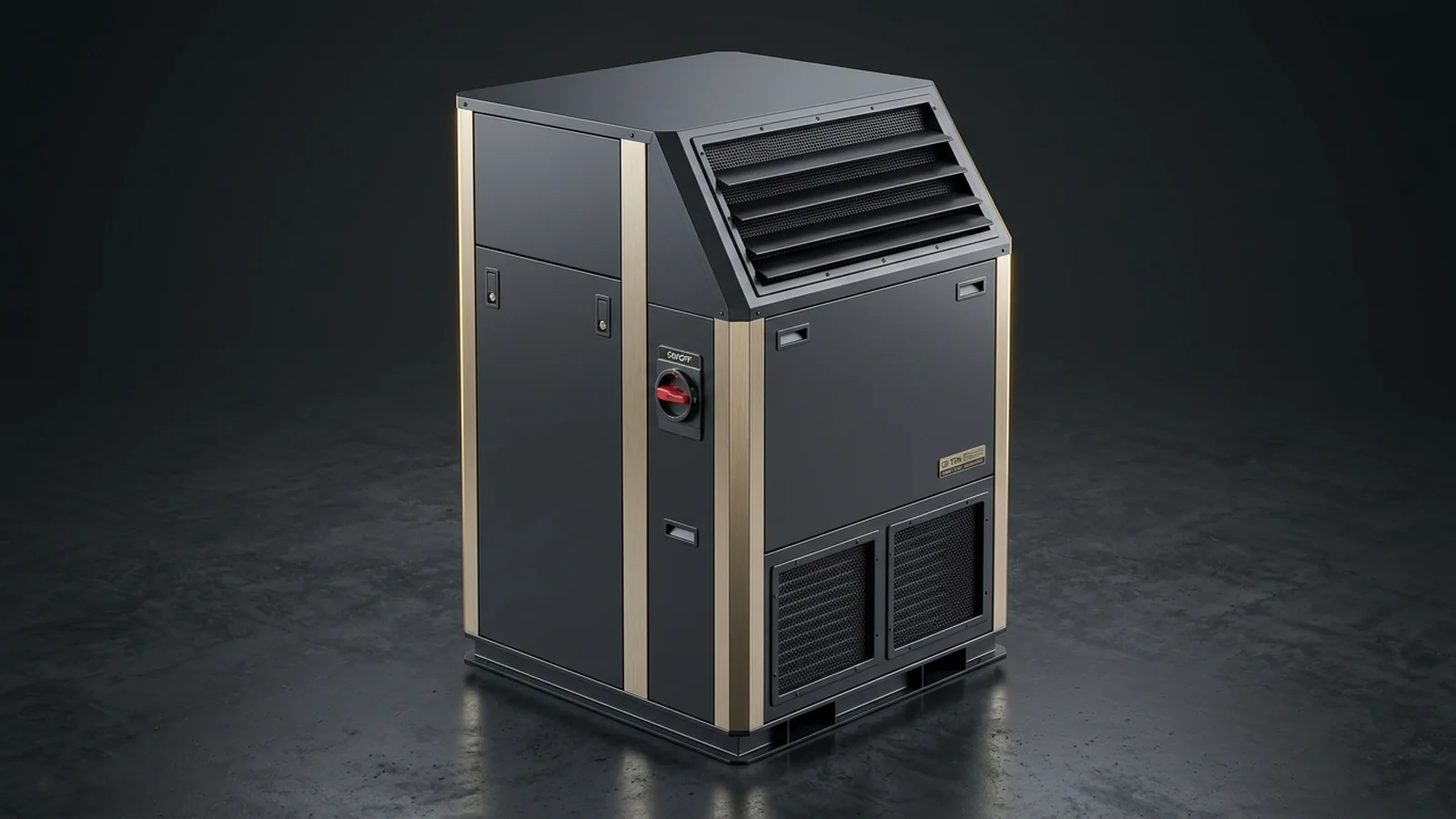
20 Ton Commercial Floor-Standing HVAC Cabinet (FD-HVAC-020)
Features dual-circuit staggered compressor start-up sequencing (Circuit 1 engages, Circuit 2 delays 15 seconds), cutting starting inrush kVA spikes by 50% on diesel generator supplies.
Model Your Venue & Estimate HVAC Tonnage in 3D
Use the Fusion Developers interactive 3D Structure & Marquee Configurator to dimension spans from 15m to 60m, simulate guest heat loads, and compute instant multi-currency Bill of Quantities (BOQ).
Related Commercial HVAC Engineering Dossiers
Marquee Tonnage Sizing: Sq Ft & Guest Count
Determine equipment quantities and load.
Capex vs Rental HVAC Analysis in Pakistan
Compare generator fuel costs and operating expenses.
Faisalabad Industrial Banquet HVAC Guide
Integration with industrial sub-stations and generators.
Engineering & Procurement Inquiries
Q: What size generator is needed to run an 80-ton marquee cooling setup?
An 80-ton cooling setup (four 20-ton cabinets) draws approximately 133 kW of continuous electrical power. Utilizing staggered step-starting sequencing, a 200 kVA to 250 kVA prime-rated diesel generator provides optimal stability and reliability.
Q: Why is compressor Locked Rotor Amps (LRA) dangerous for generators?
LRA is the momentary starting inrush current, typically 4 to 6 times higher than normal running current. If multiple compressors start simultaneously, this surge can collapse generator alternator voltage and stall the diesel engine.
Q: What circuit breaker trip curve is required for commercial HVAC cabinets?
Type D circuit breakers are required. They tolerate momentary inrush currents up to 10–14 times nominal rating without nuisance tripping, unlike Type C breakers which can trip on compressor startup.
Q: What happens if 3-phase power is connected with reversed phase sequence to a scroll compressor?
Scroll compressors can only rotate in one direction. Reverse rotation causes immediate loss of lubrication and mechanical seizure within seconds. Built-in phase sequence relays prevent startup until wiring is corrected.
Request Stamped Psychrometric Calculations or Tender BOQ
Our senior mechanical HVAC engineers provide certified thermal heat balance assessments, electrical single-line schematics, and factory-direct equipment supply across Pakistan.
Consult Chief Engineer on WhatsApp (+92 332 2227426)