Condensation Physics & Dew Point Control: Preventing Fabric Sweating in Tensile Marquees
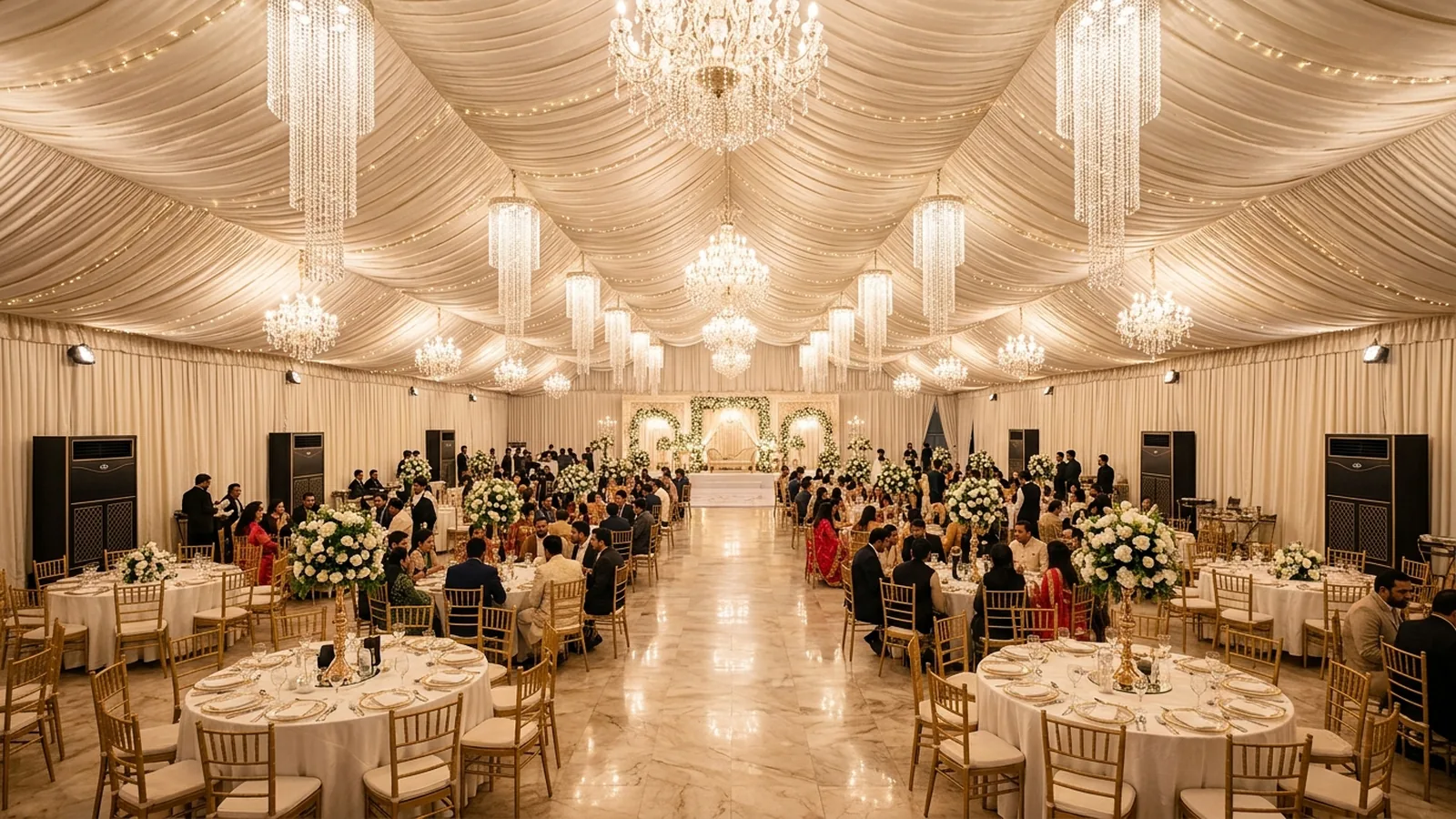
During Punjab and Sindh monsoon seasons (July through September), ambient relative humidity routinely surges beyond 85% RH. In poorly engineered temporary venues, moist indoor air comes into contact with cold fabric surfaces or un-insulated roof framing, causing severe condensation, fabric sweating, and 'indoor rain' falling on banqueting guests.
1. Psychrometric Dew Point Physics in Tensile PVC Structures
Condensation occurs when the surface temperature of an interior architectural boundary drops below the dew point temperature (T_dp) of the adjacent indoor air volume. In psychrometrics, dew point is the temperature at which water vapor in moist air reaches 100% saturation and begins condensing into liquid phase: T_dp approximately = T - ((100 - RH) / 5).
For an indoor marquee condition of 23°C (73.4°F) and 65% Relative Humidity, the psychrometric dew point is 16.0°C (60.8°F). If ambient evening air outdoors cools down following a monsoon downpour to 24°C while cold air conditioned air chills the un-insulated thin PVC fabric (U-value 5.8 W/m²K) down to 15°C, moisture immediately condenses across the fabric inner surface.
Once water droplets form on the ceiling membrane, surface tension holds them until droplet mass exceeds adhesive capillary force. At that threshold, droplets coalesce and drip down into chandeliers, food display stations, and evening bridal wear—an intolerable failure known across the hospitality industry as 'tent rain'.
DEW POINT AVOIDANCE CRITERIA:
T_surface_inner > T_indoor_dewpoint + 2.5°C
To guarantee zero condensation at 22°C dry bulb, indoor RH must be actively driven down to <= 50% RH,
which lowers the space dew point to 11.1°C—well below any structural fabric surface temperature.
2. Monsoon Humidity Spikes (85%+ RH in July–August)
The monsoon climatic corridor covering Lahore, Gujranwala, Sialkot, and Rawalpindi generates extreme outdoor moisture loads. Ambient moisture content during July and August routinely spikes to 140–165 grains of moisture per pound of dry air (w = 0.020 to 0.0235 kg/kg dry air) at dry-bulb temperatures between 34°C and 38°C.
When ventilation air or uncontrolled perimeter air infiltration introduces this saturated outdoor air into the marquee, the latent heat load dwarfs the sensible cooling load. Furthermore, a seated audience of 1,000 guests generates approximately 200,000 BTU/hr of latent moisture dissipation—releasing roughly 85 to 95 liters of liquid water vapor into the air volume every hour through respiration and skin perspiration.
Without continuous high-capacity latent heat extraction, indoor relative humidity rapidly spirals above 75% RH. Under high humidity, human evaporative cooling mechanisms stall, making 22°C feel clammy, sticky, and suffocating.
3. 6-Row Deep Evaporator Coil Latent Heat Extraction Dynamics
Standard residential and light commercial package units utilize shallow 2-row or 3-row evaporator coils with high face velocities (>2.8 m/s). Shallow coils provide rapid sensible heat cooling but exhibit poor contact factor (bypass factor BF > 0.25), meaning a large fraction of the moist air passes through the coil without reaching saturation and shedding moisture.
Fusion Developers cabinets feature heavy-duty 6-row deep evaporator coils constructed with inner-grooved rifled copper tubing and hydrophilic blue-fin aluminum fins spaced at 12 to 14 fins per inch (FPI). Face velocity is controlled to a conservative 2.0 to 2.2 m/s (400 to 440 FPM).
This expanded fin depth and optimized contact dwell time reduces the coil bypass factor to below 0.08 (92%+ contact factor). Moist return air is thoroughly chilled below its apparatus dew point (ADP = 9.5°C to 10.5°C), forcing massive water vapor condensation across the fin matrix. A single 20-ton cabinet extracts 40 to 48 liters of liquid moisture per hour, continuously purging moisture from the marquee.
4. Airflow Stratification & Stagnant Corner Elimination
Condensation does not occur uniformly throughout a marquee; it concentrates in stagnant microclimate dead-zones—specifically gable roof peaks, corners behind stage curtains, and perimeter fabric folds where air velocity drops to near zero.
In stagnant zones, radiant heat loss to the night sky rapidly drops fabric temperature, while trapped humid air provides an endless supply of water vapor. To prevent localized sweating, air circulation within the marquee must maintain a continuous minimum air movement of 0.25 to 0.35 m/s across all interior fabric surfaces.
Fusion Developers units utilize high-velocity aerodynamic discharge louvers capable of throwing air up to 30 meters. By angling discharge grilles at a 35° upward trajectory, conditioned air washes the ceiling membrane, continuously sweeping away stagnant boundary layers and maintaining fabric surface temperatures above the space dew point.
5. Sloped Antimicrobial Condensate Sump Systems & High-Head Pumping
Extracting 150 to 250 liters of water per hour across a multi-cabinet marquee setup introduces significant wastewater management challenges. Flat, shallow condensate pans found in standard units often overflow when units are set on slightly un-level temporary terrain, causing water to spill onto ballroom carpets.
Fusion Developers cabinets incorporate heavy-gauge Grade 304 stainless steel condensate drain trays with multi-directional 2% gravity slopes toward dual drain ports. The stainless steel surface is treated with an antimicrobial powder coating to prevent algae and slime buildup in warm environments.
Each cabinet is equipped with an integrated high-head centrifugal condensate removal pump (pumping head up to 6.5 meters vertical lift) with a dual-float safety switch. If a drainage line is kinked or blocked, the upper float switch automatically engages an alarm and stages down compressor circuits before tray overflow can occur.
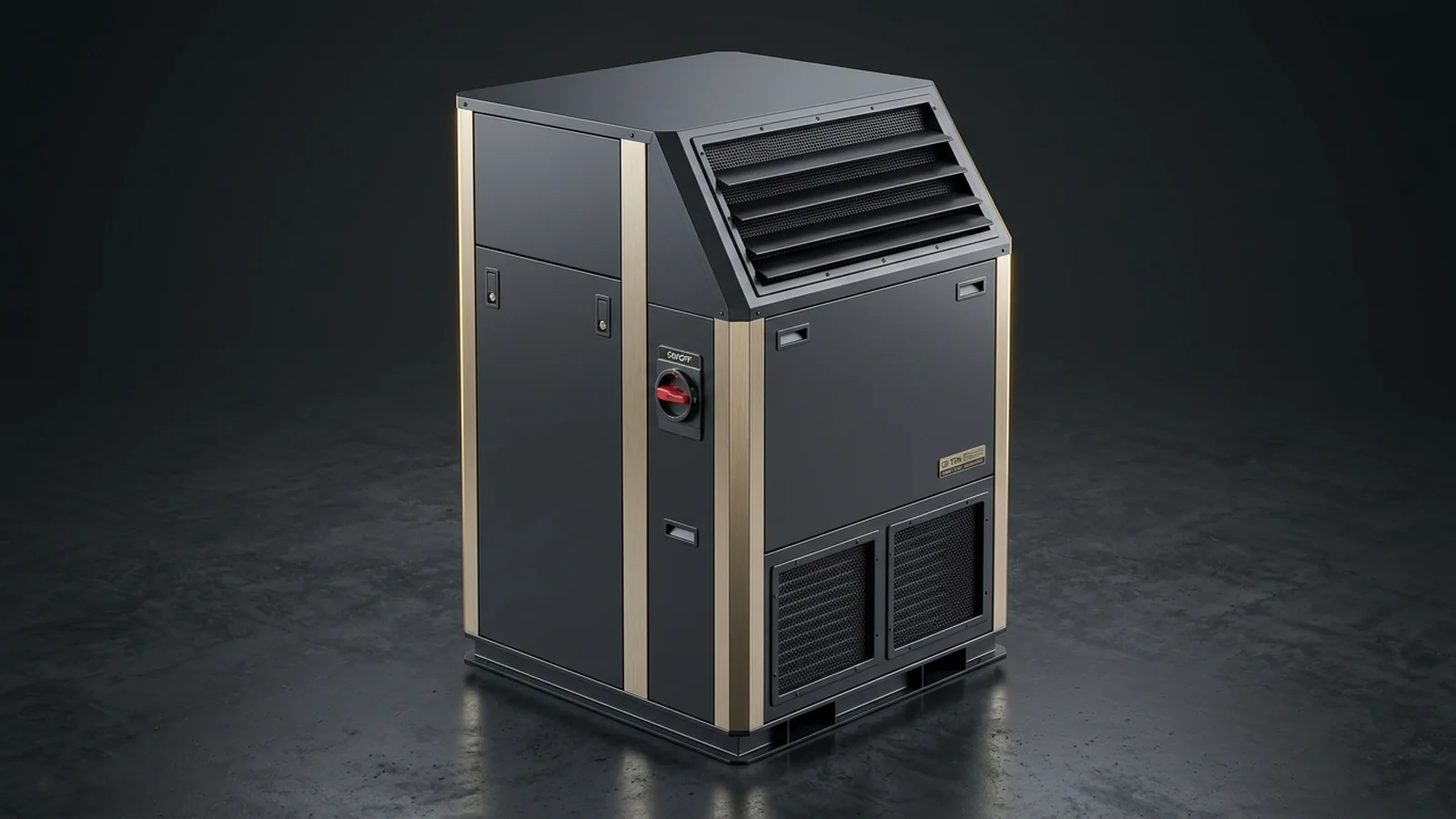
20 Ton Commercial Floor-Standing HVAC Cabinet (FD-HVAC-020)
Engineered with 6-row deep hydrophilic blue-fin evaporator coils and dual independent refrigeration circuits, extracting up to 48 liters of condensate moisture per hour under humid monsoon conditions.
Model Your Venue & Estimate HVAC Tonnage in 3D
Use the Fusion Developers interactive 3D Structure & Marquee Configurator to dimension spans from 15m to 60m, simulate guest heat loads, and compute instant multi-currency Bill of Quantities (BOQ).
Related Commercial HVAC Engineering Dossiers
Lahore Luxury Marquee Cooling Guide
Tackling 85%+ monsoon humidity in Punjab.
Thermal Pull-Down in 48°C Ambient Heat
Pre-cooling strategies for high-ambient events.
Engineering & Procurement Inquiries
Q: Why does condensation or 'indoor rain' occur inside wedding marquees?
When indoor humidity is high (due to guest respiration and monsoon moisture), the dew point temperature rises. If the cold air conditioned air cools the thin un-insulated PVC fabric below that dew point, moisture condenses on the ceiling and drips down.
Q: How does coil depth affect humidity removal in commercial AC units?
A 6-row deep evaporator coil increases air contact dwell time and reduces the bypass factor to below 0.08. This cools entering air thoroughly below its apparatus dew point, extracting up to 48 liters of moisture per hour per 20 tons of cooling.
Q: What indoor relative humidity should be maintained in a marquee during monsoons?
Indoor relative humidity should be maintained between 45% and 52% RH at 22°C dry bulb. This lowers the space dew point to roughly 11°C, preventing condensation on fabric surfaces and ensuring crisp occupant comfort.
Q: How is condensate wastewater drained in temporary event marquee setups?
Commercial cabinets feature sloped Grade 304 stainless steel drain sumps and integrated high-head centrifugal pumps capable of pumping wastewater up to 6.5 meters vertically into external drainage gullies.
Request Stamped Psychrometric Calculations or Tender BOQ
Our senior mechanical HVAC engineers provide certified thermal heat balance assessments, electrical single-line schematics, and factory-direct equipment supply across Pakistan.
Consult Chief Engineer on WhatsApp (+92 332 2227426)