Positive-Pressure Clean Air HVAC for Defense Radar & Electronics Overhaul Workshops
Overhauling active electronically scanned array (AESA) radar antennas, traveling wave tubes (TWT), and electro-optical targeting pods requires controlled cleanroom environments. Protecting sensitive defense electronics from microscopic airborne particulates demands strict positive room pressure differentials (+15 to +30 Pa) and medical-grade multi-stage HEPA filtration.
1. Cleanroom Airborne Particulate Standards (ISO 14644-1 Class 7/8)
Military radar assemblies and electronic countermeasure (ECM) pods contain precision microwave waveguides, gold-bonded wire interconnects, and high-voltage power supplies operating at 15,000 to 25,000 Volts. In high-voltage microwave assemblies, a single microscopic airborne dust particle (>=5 microns) bridging two high-voltage traces can initiate dielectric breakdown, corona arcing, and explosive RF transmitter failure.
Under international cleanroom standards (ISO 14644-1 and US Federal Standard 209E), radar overhaul workshops must be classified as ISO Class 7 (Class 10,000) or ISO Class 8 (Class 100,000). An ISO Class 7 space limits airborne particulate count to no more than 352,000 particles per cubic meter of size 0.5 microns or larger.
Achieving and maintaining this particulate cleanliness while handling continuous cooling loads requires a dedicated cleanroom HVAC design: high air change rates (20 to 35 air changes per hour, ACH), continuous laminar air circulation, and multi-stage cascade filtration.
CLEANROOM PARTICULATE THRESHOLDS (ISO 14644-1):
- ISO Class 7: Max 352,000 particles/m³ at >=0.5 um | Recommended ACH: 20–30 ACH
- ISO Class 8: Max 3,520,000 particles/m³ at >=0.5 um | Recommended ACH: 15–20 ACH
- Airflow Velocity: 0.20 to 0.35 m/s through terminal HEPA ceiling modules.
2. Positive Pressure Differential Engineering (+15 to +30 Pa Cascade)
The primary defense mechanism preventing dust from entering a defense cleanroom is Positive Differential Pressure. Rather than allowing dust-laden outdoor air to infiltrate through wall joints, cable penetrations, or door cracks, cleanroom air pressure is held intentionally higher than adjacent corridors.
According to cleanroom engineering principles, clean areas are arranged in a pressure cascade: The primary Radar Assembly Bay is maintained at +30 Pa relative to outdoor ambient pressure. The Personnel Gowning Airlock is maintained at +15 Pa, and the external unconditioned corridor is at 0 Pa.
Whenever an airlock door is opened, clean air rushes outward at high velocity (>1.5 m/s across the door gap), physically preventing airborne dust, pollen, or outdoor sand particles from penetrating into the clean assembly zone.
3. 3-Stage Filtration Cascade: MERV 8 + MERV 14 + H14 HEPA
To prevent premature blinding of expensive cleanroom filters, air filtration must be implemented across an engineered 3-Stage Progressive Cascade.
Stage 1 (Pre-Filtration): Washable synthetic deep-pleat pre-filters rated MERV 8 (ISO ePM10 50%). These capture coarse fibers, lint, and particles larger than 3.0 microns, protecting the internal blower and cooling coils.
Stage 2 (Secondary Fine Filtration): Rigid V-bank micro-glass fiber filters rated MERV 14 (ISO ePM1 75%), which capture sub-micron dust particles (0.3 to 1.0 micron) with 85%+ efficiency.
Stage 3 (Terminal Ultra-Filtration): High-Efficiency Particulate Air (H14 HEPA) filters constructed with micro-fiberglass paper separated by aluminum foil pleats, certified to trap 99.995% of particulates down to 0.3 microns under EN 1822 test standards.
By progressively removing particle mass in Stages 1 and 2, terminal HEPA filters achieve an operational service life exceeding 36 months under continuous military workshop duty.
4. Active Differential Pressure Sensors & Modulating Air Dampers
Maintaining a stable +25 Pa pressure differential is a dynamic control challenge. Over time, outdoor wind gusts strike exterior walls, exhaust fume hoods in chemical cleaning stations cycle on and off, and air filters gradually load with dust, increasing static airflow resistance.
Fusion Developers cleanroom cabinets incorporate active closed-loop pressure control. Precision digital differential pressure transmitters (measuring 0 to 50 Pa with +/-0.5 Pa accuracy) continuously monitor room-to-corridor pressure differences.
The microprocessor controller modulates high-torque Belimo motorized fresh-air intake dampers. If room pressure drops below +20 Pa, the fresh-air damper opens proportionally, injecting additional outdoor makeup air into the recirculated air stream until room pressure returns to the target setpoint.
5. Airlock Entry Thermal Stabilization & Contaminant Purging
Personnel entry is the leading source of cleanroom contamination. When technicians enter from unconditioned corridors, their clothing carries micro-fibers, skin flakes, and outdoor thermal heat.
Airlocks must serve as both aerodynamic contamination barriers and thermal buffers. Our HVAC systems incorporate an auxiliary high-velocity air shower interlock in the gowning airlock. High-velocity HEPA-filtered air nozzles (air speed >22 m/s) blow across entering personnel for 15 seconds, dislodging surface particulates into floor return grilles.
Simultaneously, airlock supply air is maintained at 20°C with an elevated air change rate (45 ACH) to immediately dissipate heat and moisture from entering personnel before they step into the primary radar calibration cleanroom.
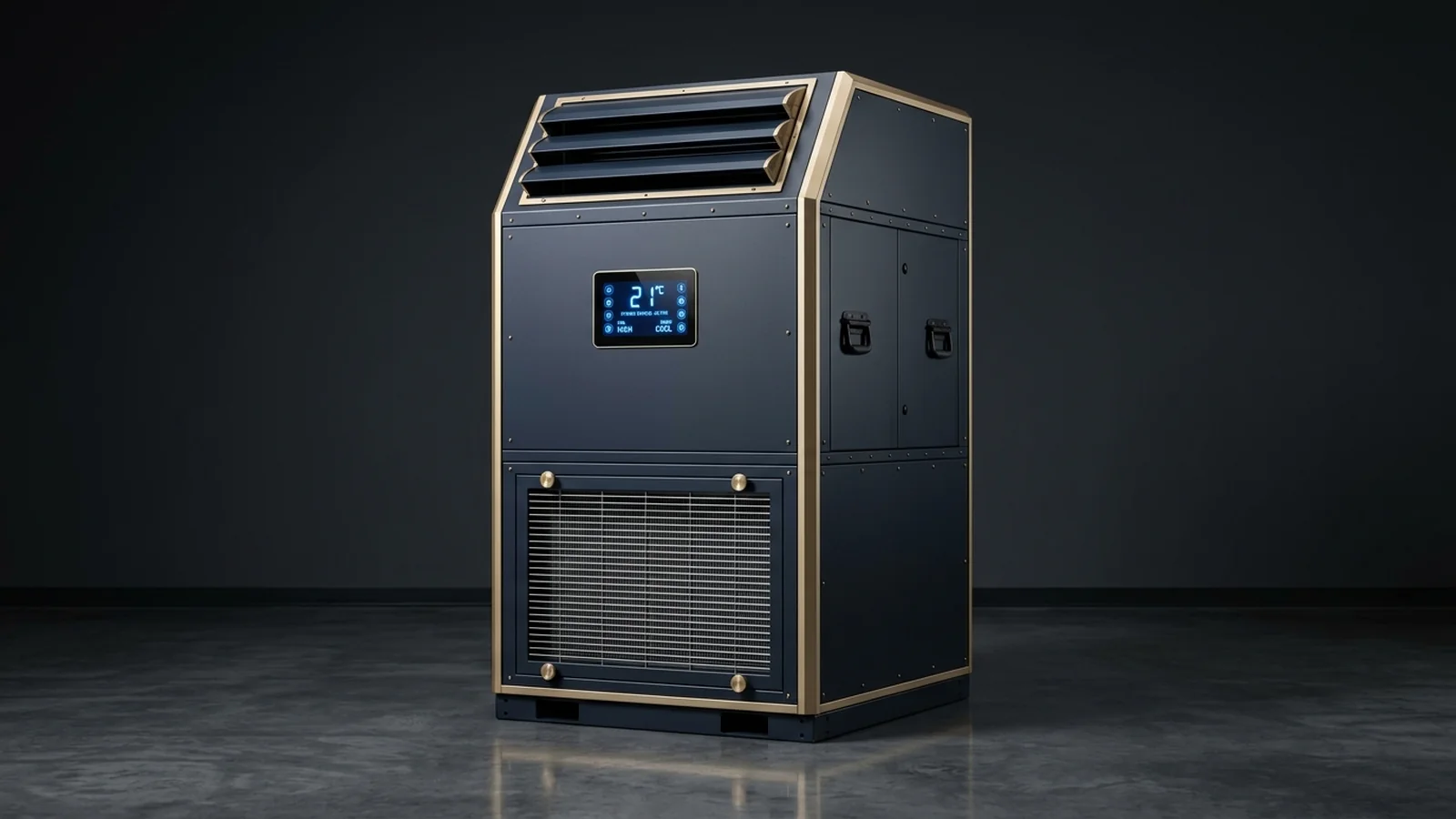
10 Ton Commercial Floor-Standing HVAC Cabinet (FD-HVAC-010)
Equipped with high-static backward-curved blowers capable of driving air through multi-stage MERV 14 and H14 HEPA filter banks, maintaining positive pressure cleanroom integrity.
Model Your Venue & Estimate HVAC Tonnage in 3D
Use the Fusion Developers interactive 3D Structure & Marquee Configurator to dimension spans from 15m to 60m, simulate guest heat loads, and compute instant multi-currency Bill of Quantities (BOQ).
Related Commercial HVAC Engineering Dossiers
HVAC for Avionics Test Benches & Simulators
Precision ±1°C tolerance climate control for aviation depots.
Spark-Free HVAC in Aviation Ordnance Zones
ATEX and spark-proof equipment for munition bays.
Desert-Rated T3 Heavy Sand Filtration
Inertial sand separators for forward operating bases.
Engineering & Procurement Inquiries
Q: Why is positive air pressure (+25 Pa) required in radar overhaul workshops?
Positive pressure ensures that air always flows outward when doors open. This creates an invisible barrier that prevents dust and contaminants from entering the cleanroom, where microscopic particles can short-circuit high-voltage radar electronics.
Q: What filter stages are used to achieve ISO Class 7/8 cleanliness?
A 3-stage progressive cascade: MERV 8 pre-filters trap coarse lint, MERV 14 fine filters trap sub-micron dust, and terminal H14 HEPA filters trap 99.995% of particles down to 0.3 microns.
Q: How does cleanroom HVAC maintain constant pressure when doors open?
Precision differential pressure sensors monitor room pressure in real time. If pressure drops, microprocessor controllers modulate motorized makeup air dampers, injecting more air to hold the positive pressure setpoint.
Q: What cleanroom air change rate (ACH) is required for defense electronics?
ISO Class 8 cleanrooms require 15 to 20 air changes per hour (ACH), while ISO Class 7 cleanrooms require 25 to 35 ACH to continuously filter out airborne particulates shed by personnel and processes.
Request Stamped Psychrometric Calculations or Tender BOQ
Our senior mechanical HVAC engineers provide certified thermal heat balance assessments, electrical single-line schematics, and factory-direct equipment supply across Pakistan.
Consult Chief Engineer on WhatsApp (+92 332 2227426)