Spark-Free Explosion-Resistant HVAC Engineering for Aviation Ordnance & Munitions Depots
Aviation ordnance maintenance bays, missile assembly facilities, and subterranean ammunition storage bunkers house sensitive solid propellants, volatile explosive compounds, and weaponized aviation fuel vapors. Climate control equipment operating in these hazardous zones must eliminate all electrical spark, mechanical friction, and electrostatic ignition sources under strict ATEX and NEC 500 standards.
1. Hazardous Atmosphere Classification: NEC 500 Class I Div 2 / ATEX Zone 2
Military aviation weapons facilities—where air-to-air missiles (AIM-9L, PL-15, SD-10), laser-guided bombs (LGB), and aircraft fuel drop tanks are assembled, tested, and stored—are legally classified as Hazardous (Classified) Locations under NFPA 70 (National Electrical Code NEC 500/505) and European ATEX Directive 2014/34/EU.
These facilities fall under Class I, Division 2, Groups C & D, or ATEX Zone 2 (Category 3G). In these zones, flammable gases or volatile vapors (such as aviation fuel vapors, JP-8 kerosene, hydrazine, and explosive solvent fumes) are not normally present in ignitable concentrations during routine operations, but may accidentally accumulate due to container leaks, valve failures, or maintenance accidents.
Under defense safety mandates, all heating, ventilation, and air conditioning equipment installed within these hazardous boundaries must be certified intrinsically safe. A standard commercial HVAC unit—with sparking mechanical contactors, brushed fan motors, and hot electrical elements—represents a lethal potential ignition source capable of detonating an entire weapons depot.
HAZARDOUS LOCATION SAFETY CERTIFICATION CRITERIA:
- Classification: NEC Class I, Division 2, Groups C & D / ATEX II 3G Ex ec nC ic IIC T4 Gc
- Temperature Class: T4 (Maximum external surface temperature <= 135°C / 275°F)
- Ingress Protection: Minimum IP66 for all electrical termination enclosures
- Spark Prevention: AMCA Type A/B non-sparking fan construction standards.
2. Non-Sparking Spark-Proof Brass-Tipped Aluminum Blower Impellers
In standard commercial blower fans, if an impeller shifts on its shaft or a foreign metal object enters the scroll housing, steel-on-steel mechanical friction generates high-temperature sparks exceeding 1,200°C—far above the auto-ignition temperature of explosive vapors (JP-8 auto-ignition is 210°C).
Fusion Developers explosion-resistant cabinets adhere strictly to AMCA Standard 99-0401 (Classification for Spark Resistant Construction). Fan impellers are fabricated entirely from non-ferrous, spark-resistant aluminum alloys.
Furthermore, the casing inlet ring and blower cutoff tongues are fitted with heavy brass or copper rubbing rings. If physical contact occurs between the rotating wheel and stationary scroll housing during high-shock explosive concussion events, non-ferrous brass-on-aluminum contact generates zero incendiary mechanical sparks, completely eliminating mechanical friction ignition risks.
3. Hermetically Sealed NEMA 7/9 Enclosures & Solid-State Switching
Electrical arcing across mechanical relay contacts, magnetic contactors, and thermostat switches is the most common ignition vector in standard HVAC machinery. In hazardous ordnance zones, all electrical switching must be isolated.
All high-voltage electrical components (contactors, circuit breakers, motor starters) are housed inside heavy cast-aluminum or cast-iron NEMA 7 (Explosion-Proof) and NEMA 9 (Dust-Ignition-Proof) enclosures. These heavy enclosures feature precision-machined ground flanged joints engineered to contain an internal explosion without igniting the surrounding explosive atmosphere outdoors.
Low-voltage thermostat controls and sensor circuits operate through Intrinsic Safety Zener Barriers (Ex i). Electronic barriers restrict electrical energy entering the hazardous zone to less than 20 microjoules and less than 1.2 Volts—ensuring that even if a sensor wire is shorted or severed, the electrical spark energy is mathematically incapable of igniting an explosive vapor mixture.
4. Maximum External Surface Temperature Limits (T4 Rating <135°C)
Explosive volatile vapors can ignite without a spark if they contact a hot surface that exceeds their auto-ignition threshold. Consequently, equipment must comply with strict Temperature Classes (T-Class).
Fusion Developers hazardous location cabinets are certified to Temperature Class T4, guaranteeing that under worst-case ambient heat (52°C) and locked-rotor electrical fault conditions, no internal or external component surface exceeds 135°C (275°F).
Compressor discharge refrigeration lines—which can reach 115°C under high-ambient compression—are enclosed in thick closed-cell elastomeric insulation with an outer stainless steel sheet cladding. Electric auxiliary heating elements are fully encapsulated within explosion-proof finned steel tubes with dual independent over-temperature limit switches that cut power if surface temperature reaches 120°C.
5. Static-Dissipative Earthing Braid & Grounding Architecture
High-velocity airflow moving through sheet metal ducts can generate immense static electricity charges through triboelectric friction. In an ammunition storage bunker, a static spark jumping from a duct flange to a missile warhead casing could trigger explosive electro-explosive devices (EEDs).
All structural panels, internal blower assemblies, motor shafts, and duct flanges in our hazardous location cabinets are interconnected via continuous tinned-copper bonding braids (cross-sectional area 16 mm²). Motor shafts incorporate conductive carbon brush grounding rings that dissipate static charge directly from the rotating impeller to earth.
The entire cabinet assembly connects to the facility's master ground grid through dual stainless steel grounding studs, maintaining an ultra-low ground loop resistance of less than 1.0 Ohm, completely eliminating static charge accumulation.
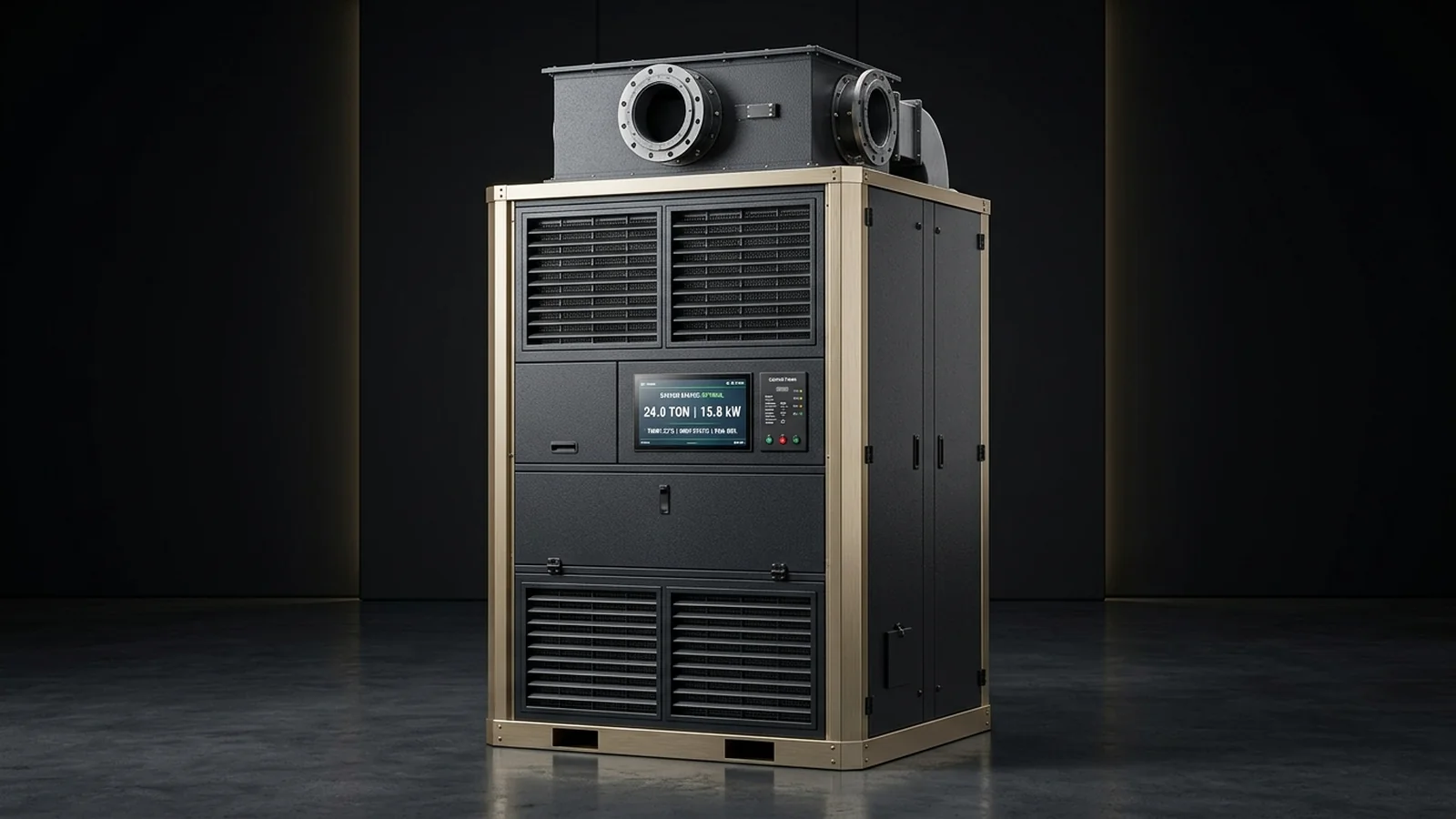
24 Ton High-Static Commercial HVAC Cabinet (FD-HVAC-024)
Custom-engineered with non-sparking spark-proof brass-tipped aluminum blower impellers, NEMA 7/9 explosion-proof electrical housings, and intrinsically safe control circuits certified for hazardous ordnance facilities.
Model Your Venue & Estimate HVAC Tonnage in 3D
Use the Fusion Developers interactive 3D Structure & Marquee Configurator to dimension spans from 15m to 60m, simulate guest heat loads, and compute instant multi-currency Bill of Quantities (BOQ).
Related Commercial HVAC Engineering Dossiers
PAF High-Bay Aircraft Hangar Climate Engineering
High-bay climate control for aircraft maintenance hangars.
Positive-Pressure Clean Air for Defense Radar
ISO Class 7/8 cleanroom filtration for radar electronics.
Hangar Portal Thermal Insulation & Air Curtains
Aerodynamic air barrier engineering across mega-doors.
Engineering & Procurement Inquiries
Q: What makes an HVAC unit explosion-resistant in an ordnance depot?
An explosion-resistant unit uses non-sparking brass-tipped aluminum blower fans, NEMA 7/9 cast explosion-proof electrical boxes, intrinsically safe low-energy sensor circuits, and strict T4 temperature limits (<135°C) to eliminate all sparks and hot spots.
Q: What is ATEX Zone 2 and Class I Division 2 in military facilities?
These are hazardous location classifications where explosive gases or volatile vapors (such as fuel vapors or missile propellant fumes) may be present during accidental leaks or maintenance operations, requiring certified spark-free equipment.
Q: How do non-sparking blower impellers work?
Impellers are made from spark-free aluminum with brass inlet rings (AMCA Type A/B construction). If the fan wheel rubs against the housing, non-ferrous brass-on-aluminum contact cannot produce friction sparks, preventing vapor ignition.
Q: Why is static electricity grounding so critical in ammunition bunkers?
High-velocity air movement generates static electricity. In an ordnance bunker, a static spark jumping to an electro-explosive device (EED) could trigger a missile warhead. Heavy copper bonding straps keep static resistance under 1.0 Ohm.
Request Stamped Psychrometric Calculations or Tender BOQ
Our senior mechanical HVAC engineers provide certified thermal heat balance assessments, electrical single-line schematics, and factory-direct equipment supply across Pakistan.
Consult Chief Engineer on WhatsApp (+92 332 2227426)