Avionics Depot & Flight Simulator Climate Engineering: Precision ±1°C Environmental Control
Aircraft avionics test benches, radar calibration workshops, and full-motion combat flight simulator bays house ultra-sensitive multi-million dollar aviation electronics. These facilities demand strict ±1.0°C temperature stability, precise 45%–55% RH humidity regulation to prevent electrostatic discharge, and micro-perforated air distribution.
1. Strict ±1°C Temperature & ±5% RH Tight Tolerance Mandates
Aviation maintenance depots tasked with testing Line Replaceable Units (LRUs)—such as radar signal processors, inertial navigation units (INU), mission computers, and fly-by-wire flight control computers—operate under stringent aerospace calibration standards (MIL-STD-810H and FAA Part 145).
Calibration instruments, spectrum analyzers, and automated test stations (ATS) exhibit subtle component drift if ambient temperature fluctuates. Thermal cycling introduces measurement inaccuracies in high-frequency microwave circuits (X-band and Ku-band radar testing) and laser gyroscope alignment.
Consequently, depot climate systems must maintain room conditions within a strict tolerance band of 21.0°C +/- 1.0°C (69.8°F +/- 1.8°F) and 50% +/- 5% Relative Humidity 24 hours a day, regardless of whether outdoor temperatures are soaring at 47°C or dropping to 4°C.
PRECISION CONTROL TOLERANCE ENVELOPE:
- Dry-Bulb Temperature: 21.0°C +/- 1.0°C
- Relative Humidity: 50% RH +/- 5.0% RH
- Maximum Rate of Temperature Change: <= 1.5°C per hour
- Particle Cleanliness: Class 8 (ISO 14644-1) with HEPA final filtration.
2. Electrostatic Discharge (ESD) Prevention via 45%–55% RH Control
Electrostatic Discharge (ESD) is the single greatest hidden hazard in avionics depot facilities. When technicians handle printed circuit boards containing gallium arsenide (GaAs) or sub-nanometer CMOS semiconductors, micro-static charges can cause catastrophic gate oxide breakdown.
Relative humidity is the critical physical governing factor in static charge dissipation. At high humidity (>65% RH), microscopic moisture films on surfaces cause corrosion on silver-plated gold connectors and encourage tin-whisker growth. Conversely, when humidity drops below 35% RH, surface resistivity skyrockets from 10^9 to over 10^13 ohms per square, allowing triboelectric charges up to 25,000 Volts to accumulate on technicians walking across the floor.
Fusion Developers precision cabinets integrate active dual-modality humidity management: deep-row cooling coils extract excess monsoon moisture, while integrated electrode steam humidifiers inject pure, sterile vapor when dry winter weather threatens to lower humidity below 45% RH.
3. Vibration-Free High-Static Micro-Perforated Duct Integration
Full-motion flight simulators (Level D CAE/Thales systems) feature 6-degree-of-freedom hydraulic or electro-mechanical motion hexapod bases supporting a full-cockpit visual dome. Air conditioning supply ducts cannot be rigidly connected to the moving simulator pod.
Furthermore, high-velocity turbulent air discharge from metal grilles generates acoustic roar and drafts that disrupt flight simulator cockpit audio headsets and pilot immersion. The climate system must deliver massive air volumes silently and uniformly.
Conditioned air is delivered through overhead micro-perforated flame-retardant fabric ducting (Sox duct). Thousands of laser-cut precision micro-perforations distribute air via low-velocity displacement (exit velocity <0.8 m/s), providing perfectly uniform temperature distribution across the cockpit without creating intrusive drafts or acoustic turbulence.
4. Clean Agent Fire Suppression (FM-200 / Novec 1230) Exhaust Interlocks
Avionics cleanrooms and flight simulator bays are protected by total-flooding clean agent gaseous fire suppression systems (FM-200 / HFC-227ea or 3M Novec 1230 / FK-5-1-12) to protect multi-million dollar electronics from water damage.
If a fire is detected, the HVAC system must interface directly with the fire alarm control panel (FACP). Within 2.0 seconds of first-stage smoke detection, the HVAC supply and return blowers must immediately shut down, and motorized fire/smoke dampers must snap closed to seal the room.
This containment prevents the gaseous extinguishing agent from being diluted or sucked out of the room before achieving extinguishing concentration (typically 7.9% volume concentration for 10 minutes retention time). Following agent discharge, the HVAC controller activates a dedicated post-fire purge exhaust mode to safely vent fluorinated gas breakdown products outdoors.
5. 24/7 Redundant Staging for Flight Simulator Computing Racks
A modern fighter flight simulator incorporates high-density visual image generator (IG) computing racks, rendering photorealistic 8K tactical environments in real time. These server racks generate over 25 kW (85,300 BTU/hr) of concentrated heat inside a compact equipment room.
Fusion Developers deploys Dual-Cabinet Auto-Changeover Staging. Two identical 10-ton cabinets share the cooling load under normal operations. Every 12 hours, the lead/lag sequence alternates to equalize compressor wear.
If the active unit detects an electrical fault, high discharge pressure, or room temperature rising above 23°C, the standby cabinet starts up instantaneously, sending an SNMP alert to the base avionics duty officer while ensuring uninterrupted flight training operations.
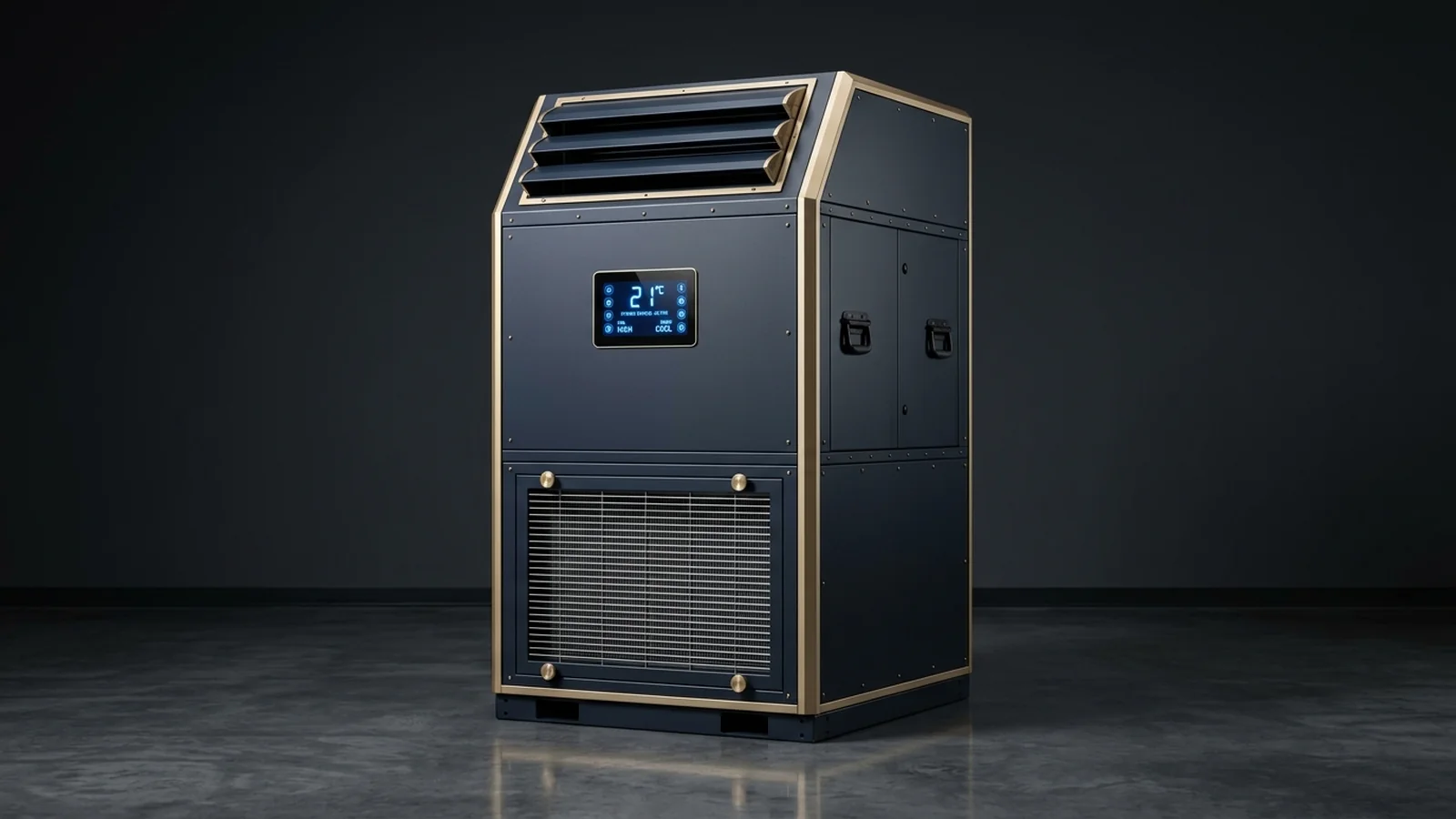
10 Ton Commercial Floor-Standing HVAC Cabinet (FD-HVAC-010)
Precision climate control cabinet delivering tight +/-1.0°C temperature regulation, 4,000 CFM airflow, low vibration, and clean HEPA-ready filtration for sensitive aerospace electronics depots.
Model Your Venue & Estimate HVAC Tonnage in 3D
Use the Fusion Developers interactive 3D Structure & Marquee Configurator to dimension spans from 15m to 60m, simulate guest heat loads, and compute instant multi-currency Bill of Quantities (BOQ).
Related Commercial HVAC Engineering Dossiers
PAF High-Bay Aircraft Hangar Climate Engineering
Stratification control in aircraft maintenance hangars.
Positive-Pressure Clean Air for Defense Radar
ISO Class 7/8 cleanroom filtration for radar electronics.
Spark-Free HVAC in Aviation Ordnance Zones
ATEX and spark-proof equipment for munition bays.
Engineering & Procurement Inquiries
Q: Why is ±1°C temperature stability required for avionics test benches?
Sensitive avionics components, microwave test equipment, and inertial navigation systems experience thermal drift when temperatures change. Tight ±1°C tolerance guarantees repeatable, certified calibration measurements.
Q: How does 45%–55% relative humidity prevent electrostatic discharge (ESD)?
Low humidity (<35% RH) makes air an electrical insulator, allowing static charges up to 25,000V to build up on technicians and fry microprocessors. Maintaining 45%–55% RH keeps surface resistance low, safely bleeding static charges to ground.
Q: What happens to the HVAC system when FM-200 fire suppression discharges?
The HVAC system must shut down instantly (within 2 seconds) and motorized dampers must close. This prevents the fire extinguishing gas from being diluted or blown out of the room, ensuring the fire is smothered.
Q: How is conditioned air delivered silently to full-motion flight simulators?
Using overhead laser-perforated fabric ducting. This delivers high volumes of conditioned air at ultra-low velocity (<0.8 m/s), eliminating drafts, mechanical vibrations, and acoustic blower noise inside the cockpit.
Request Stamped Psychrometric Calculations or Tender BOQ
Our senior mechanical HVAC engineers provide certified thermal heat balance assessments, electrical single-line schematics, and factory-direct equipment supply across Pakistan.
Consult Chief Engineer on WhatsApp (+92 332 2227426)