Multan & South Punjab Marquee Cooling Guide: Conquering 50°C Desert Heat & Dust Storms
South Punjab—spanning Multan, Bahawalpur, Rahim Yar Khan, and Dera Ghazi Khan—presents the most severe thermal challenge in Pakistan. Summer ambient temperatures routinely hit sustained peaks of 49°C to 51°C (124°F), accompanied by violent blinding silt and dust storms (aandhi). Standard commercial air conditioners fail catastrophically under these conditions without heavy-duty T3 tropicalization.
1. Multan Extreme Thermal Environment: Sustained 49°C–52°C Ambient Peak Sol-Air
Multan, historically known as the 'City of Heat and Dust,' sits within the arid Southern Punjab plain bordering the Thar and Cholistan deserts. During May, June, and July, solar irradiance is exceptionally intense, driving ambient dry-bulb temperatures above 48°C for weeks at a time, with all-time records exceeding 52°C (125.6°F).
Under direct desert sunlight, solar radiation absorption drives Sol-Air temperatures on marquee PVC roofs above 72°C (161.6°F). Outdoor condensing units installed on bare concrete pads or gravel yards experience entering air temperatures exceeding 54°C due to ground thermal reflection.
At 50°C ambient, standard T1 commercial air conditioners suffer extreme thermodynamic de-rating: refrigerant condensing pressures spike past 41 bar (595 psig), triggering high-pressure safety cutoffs and leaving banquet venues with zero cooling in the middle of evening festivities.
MULTAN T3 REFRIGERATION CYCLE METRICS:
- Ambient Outdoor Air: 50.0°C DB
- Condensing Temperature: 62.5°C (Saturation Pressure = 40.2 bar / 583 psig for R410A)
- Required Condenser Face Area: Minimum 2.45 m² per 10 TR of cooling
- Liquid Subcooling Target: 7.5K to prevent liquid line flash gas before TXV.
2. Silt & Dust Storm (Aandhi) Airflow Choking Prevention on Coils
A frequent, destructive climatic phenomenon in South Punjab is the sudden summer dust storm (locally known as Aandhi). Strong desert winds carry high concentrations of microscopic alluvial silt and fine sand, reducing visibility to less than 10 meters.
When condenser fans draw dust-laden air across standard tightly spaced aluminum fins (18 to 22 fins per inch), fine silt packs into the coil matrix within hours. The silt forms an insulating caked mud blanket across the coil, completely choking airflow, elevating condensing pressures, and burning out fan motors.
Fusion Developers T3 cabinets deployed in Multan utilize Desert-Optimized Condenser Coils featuring wider fin spacing (10 to 12 fins per inch) and washable coarse mesh pre-filter screens. This wider fin geometry allows airborne silt to pass through without packing, while removable screens catch larger debris, maintaining airflow during dust storm events.
3. Gold-Fin Anti-Corrosive Epoxy Coil Protection Against Saline Soil Aerosols
South Punjab's arid soil contains high concentrations of alkaline salts, sulfates, and sodium chloride. When summer dust storms deposit saline dust on outdoor condenser coils, night moisture dissolves the salts, initiating aggressive Galvanic Pitting Corrosion on bare aluminum fins.
Within 18 months, un-protected aluminum fins crumble into powdery white oxide, causing total loss of heat transfer and expensive coil replacements. Commercial cabinets in South Punjab must feature comprehensive anti-corrosive protection.
Our cabinets utilize hydrophilic Gold-Fin Epoxy Coated Coils. Aluminum fin stock is factory-coated with a modified hydrophilic epoxy resin barrier layer, followed by a baked polymer clear coat. The gold-fin treatment provides an ASTM B117 salt spray corrosion resistance exceeding 2,500 hours—multiplying coil operational life by over 300% in saline desert environments.
4. MEPCO Power Swings & Heavy Phase-Failure Relays
Multan Electric Power Company (MEPCO) operates an extensive, heavily loaded transmission grid across South Punjab. Severe voltage swings (fluctuating from 320V to 460V), sudden single-phasing (loss of one electrical phase), and frequency drops are frequent occurrences.
Running a 3-phase compressor on two phases ('single-phasing') generates massive stator overcurrent, burning out compressor motor windings within 45 seconds if unprotected. Standard thermal overloads react too slowly to prevent winding burnout.
Fusion Developers units integrate Heavy-Duty Digital Phase-Failure and Asymmetry Relays. If any single phase drops out, or if phase-to-phase voltage imbalance exceeds 7.5%, the electronic relay trips within 150 milliseconds, immediately cutting power to the contactor coil and locking out the compressor before thermal damage can occur.
5. Multi-Unit Staging Layouts for 25,000 Sq Ft Monumental Halls
Wedding venues in South Punjab (such as major halls along Multan's Bosan Road, Northern Bypass, and Bahawalpur's Circular Road) are famously monumental, frequently covering 20,000 to 30,000 square feet with 1,500 to 2,500 seated guests.
Cooling a 25,000 sq ft hall in 49°C ambient requires a massive aggregate cooling capacity of 240 to 280 Tons of Refrigeration. Centralizing this load into one massive chiller creates a single point of catastrophic failure.
The engineered solution deploys Decentralized Multi-Unit Staging using 24-ton high-static cabinets distributed along perimeter boundaries. Units are staged into groups: during daytime setup, only 30% of units operate for baseline holding. Two hours before the banquet, all units engage simultaneously, ensuring rapid thermal pull-down while providing 10-tier redundancy that guarantees the event never fails.
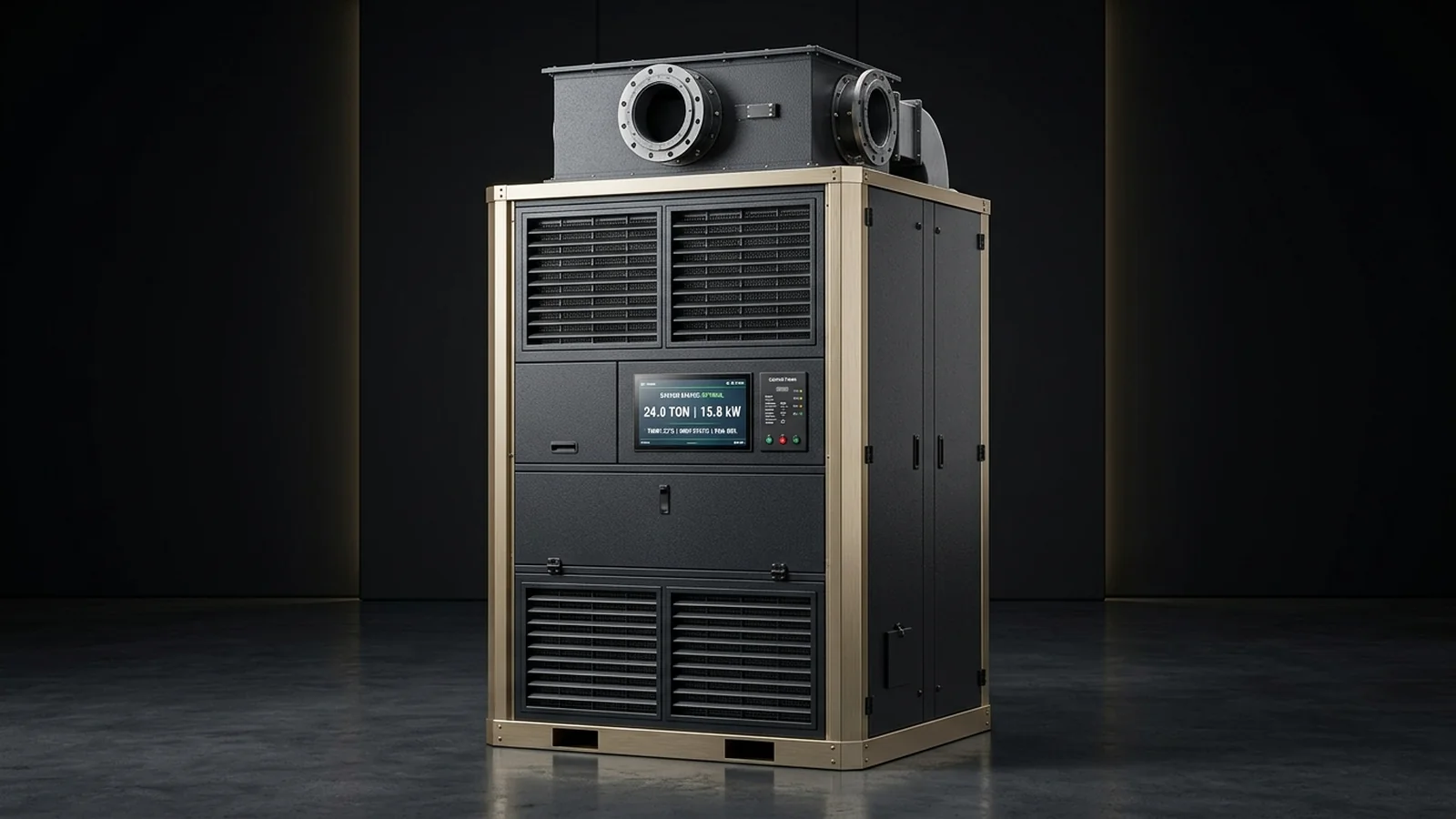
24 Ton High-Static Commercial HVAC Cabinet (FD-HVAC-024)
Heavy-duty desert-rated cooling unit featuring oversized gold-fin anti-corrosion coils, heavy sand-filtration screens, and dual Copeland scroll compressors built to run continuously in 52°C ambient heat.
Model Your Venue & Estimate HVAC Tonnage in 3D
Use the Fusion Developers interactive 3D Structure & Marquee Configurator to dimension spans from 15m to 60m, simulate guest heat loads, and compute instant multi-currency Bill of Quantities (BOQ).
Related Commercial HVAC Engineering Dossiers
Thermal Pull-Down in 48°C Ambient Heat
Pre-cooling curves and extreme heat mitigation.
Desert-Rated T3 Heavy Sand Filtration
Inertial sand separators for forward operating bases.
Lahore Luxury Marquee Cooling Guide
HVAC solutions for Punjab's flagship wedding corridor.
Engineering & Procurement Inquiries
Q: Why do standard commercial AC units fail in Multan and South Punjab?
Standard units are rated for 35°C ambient (T1 climate). In Multan's 50°C summer heat, condensing pressures exceed 600 psig, causing automatic safety shutdowns. T3 tropicalized units feature 35% larger condensers to run continuously at 52°C.
Q: How does Gold-Fin coil coating protect against desert dust?
South Punjab desert dust contains corrosive alkaline salts that eat away bare aluminum fins. Hydrophilic Gold-Fin epoxy coating seals the metal against chemical corrosion, extending coil lifespan from 2 years to over 10 years.
Q: How does wide fin spacing prevent condenser choking during sandstorms?
Standard coils have dense fin spacing (20 FPI) where fine silt packs tightly into mud. Desert-rated coils use wider 10–12 FPI spacing, allowing silt particles to pass harmlessly through without blocking airflow.
Q: What electrical protection is required for MEPCO grid power in Multan?
Fast-acting digital phase-failure relays. If one electrical phase drops out ('single-phasing') on the MEPCO grid, the relay cuts power within 150 milliseconds, preventing the compressor motor from burning out.
Request Stamped Psychrometric Calculations or Tender BOQ
Our senior mechanical HVAC engineers provide certified thermal heat balance assessments, electrical single-line schematics, and factory-direct equipment supply across Pakistan.
Consult Chief Engineer on WhatsApp (+92 332 2227426)