Aircraft Hangar Portal Climate Engineering: High-Velocity Air Curtains & Thermal Envelope Insulation
Aircraft maintenance hangars feature massive sliding door portals spanning 25 to 35 meters wide and up to 10 meters high to accommodate combat fighter jets and transport aircraft. When opened, immense outdoor thermal loads rush inside. Mastering portal aerodynamics and high-static climate distribution is critical for mission readiness.
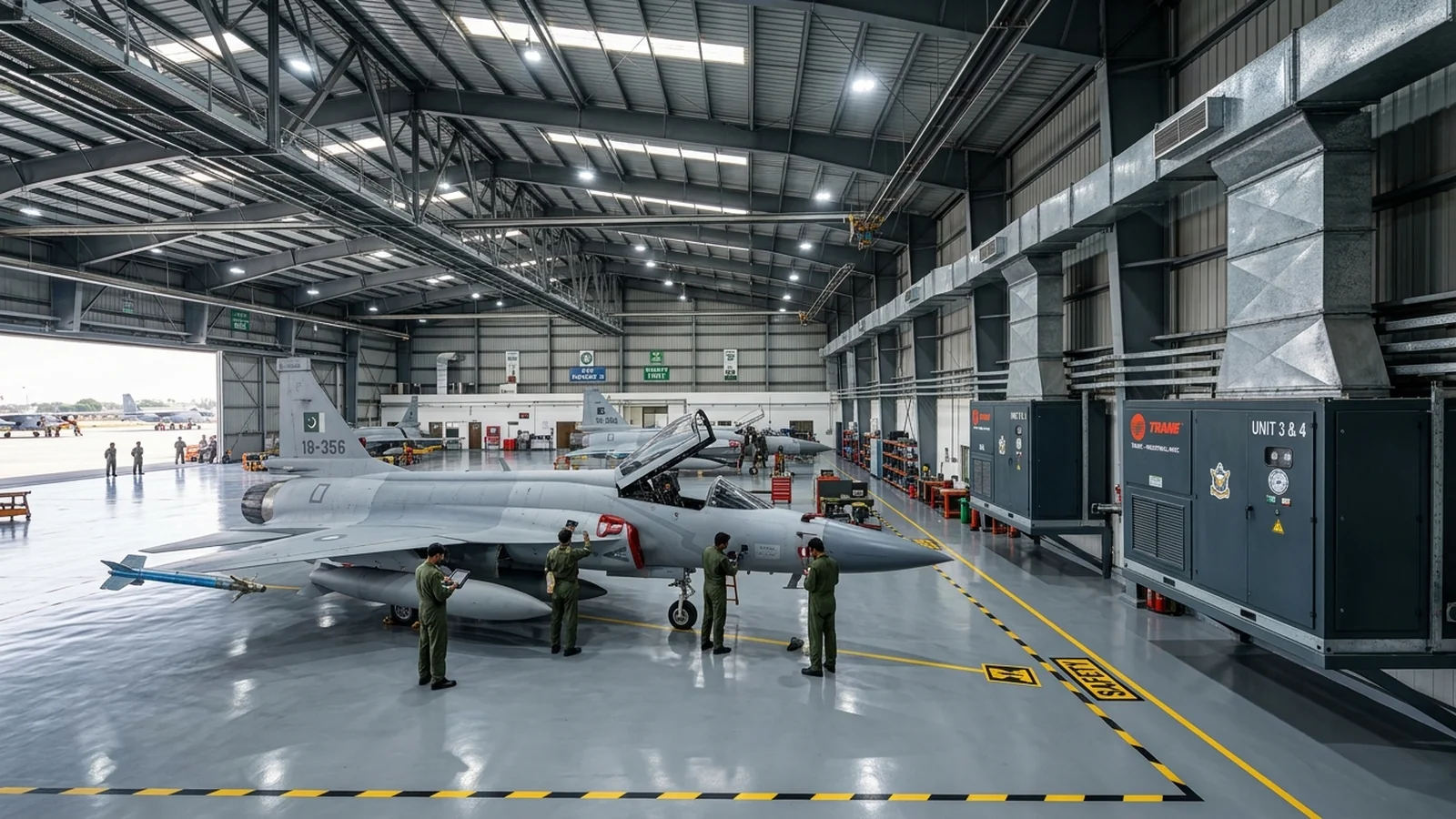
1. Infiltration Aerodynamics of Massive 30ft x 100ft Hangar Portals
Aircraft maintenance hangars operate under extreme physical boundary conditions. A typical PAF maintenance bay for JF-17 Thunder or Mirage multirole aircraft features a clear portal opening spanning 30 meters (98.4 ft) wide by 8.5 meters (27.9 ft) clear height—creating an aperture area of 255 m² (2,745 sq ft).
When sliding hangar doors are opened to taxi an aircraft, thermal infiltration is driven by two powerful aerodynamic forces: wind-driven velocity pressure P_wind = 0.5 * rho * V_wind^2, and thermal buoyancy 'stack effect' pressure P_stack = rho_indoor * g * h * ((T_outdoor - T_indoor) / T_outdoor). During summer with 46°C outdoor air and 23°C conditioned indoor air, cold dense indoor air rushes out along the floor while blistering hot outdoor air floods across the upper aperture.
Without aerodynamic containment, a 5-minute door opening can introduce over 120,000 m³ of unconditioned outdoor air, instantly collapsing indoor temperature control and taking conventional HVAC plants over 3 hours to recover.
PORTAL AIR INFILTRATION VOLUME FORMULA:
Q_infil (CFM) = 60 * C_d * A_portal * sqrt( (2 * Delta_P) / rho_air )
For a 255 m² aperture under 2.5 m/s light crosswind (Delta_P = 3.8 Pa),
uncontrolled infiltration exceeds 285,000 CFM—requiring immediate aerodynamic barrier sealing.
2. High-Velocity Laminar Air Curtain Jet Dynamics (>15 m/s Nozzles)
To preserve conditioned working environments inside high-bay maintenance hangars, heavy-duty industrial Air Curtains are positioned across the top header of the portal. An aerodynamic air curtain generates a high-velocity, planar jet of air discharged downward toward the hangar threshold.
According to fluid mechanics jet deflection theory, the core nozzle discharge velocity must exceed 15 to 18 m/s (2,950 to 3,540 FPM) with an intentional 15° to 20° outward discharge angle toward the outdoor apron. As outdoor wind pressure impacts the planar air jet, it exerts momentum transfer that deflects the jet inward, precisely balancing the external pressure vector at floor level.
When properly calibrated, the air jet splits at the floor slab, with 80% recirculating into the indoor return air intake, creating an invisible, aerodynamic fluid barrier that resists up to 80% of outdoor thermal infiltration while allowing unimpeded aircraft taxiing.
3. 80% Thermal Sealing Efficiency Benchmark Across Door Apertures
Thermal sealing effectiveness E_sealing is quantitatively defined as: E_sealing = (Q_unsealed - Q_sealed) / Q_unsealed * 100%. Under AMCA Standard 220 testing protocols, certified high-velocity industrial air barriers achieve 78% to 83% thermal containment efficiency across portal apertures up to 9 meters height.
This high sealing efficiency prevents the massive collapse of interior conditioned air. By preventing 80% of sensible outdoor heat influx during operational aircraft sorties, the base HVAC plant load spikes by only a fraction of what an unsealed portal would experience.
Furthermore, high-velocity air jets act as powerful deterrents against flying insects, airborne desert dust, and birds entering the hangar bay, safeguarding sensitive aircraft jet turbine intakes and cockpit avionics bays from foreign object debris (FOD).
4. PIR Sandwich Panel (75mm–100mm) Envelope Thermal Performance
Beyond the portal openings, the permanent hangar building envelope must achieve strict thermal performance targets under ASHRAE 90.1 aerospace facility criteria. Hangars constructed with un-insulated corrugated steel sheeting act as massive thermal radiant ovens under 48°C summer sunshine, with roof surface temperatures radiating over 350 W/m² of thermal heat into the maintenance bay.
Modern defense hangar specifications require 75mm to 100mm Polyisocyanurate (PIR) rigid core insulated sandwich panels with closed-cell microcellular foam (density 40 kg/m³, thermal conductivity lambda = 0.020 W/m·K). An 80mm PIR panel achieves an exceptional overall thermal transmittance U-value = 0.24 W/m²K (R-value = 23.6 hr·ft²·°F/BTU).
PIR foam cores also exhibit superior fire performance compared to standard polyurethane (PUF) or expanded polystyrene (EPS). Under ASTM E84 and BS 476 Part 7, PIR achieves Class 1 / Class 0 flame spread ratings, with self-extinguishing charring behavior that resists structural collapse in high-hazard aircraft fuel environments.
5. Computational Fluid Dynamics (CFD) Airflow Modeling at Portal Edges
Engineering air distribution in a 35-meter high clear-span aircraft hangar requires 3-dimensional Computational Fluid Dynamics (CFD) simulation using Reynolds-Averaged Navier-Stokes (RANS) turbulence models (k-epsilon / k-omega SST).
CFD simulations reveal that discharging conditioned air from standard low-velocity floor grilles causes cold air to pool along the floor while warm air stratifies in upper roof trusses (Archimedes thermal stratification). Conversely, discharging air from high ceilings causes the cool air jet to dissipate long before reaching ground technicians.
Fusion Developers 24-ton high-static cabinets solve this through High-Static External Pressure (350 Pa) capability. Connected to rigid spiral ducting mounted at 5.5 meters elevation, jet nozzle diffusers fire high-momentum air streams directly into aircraft maintenance working zones (elevations 0 to 3.0 meters) at 1.8 m/s, ensuring technician thermal comfort without disturbing sensitive airframe calibration sensors.
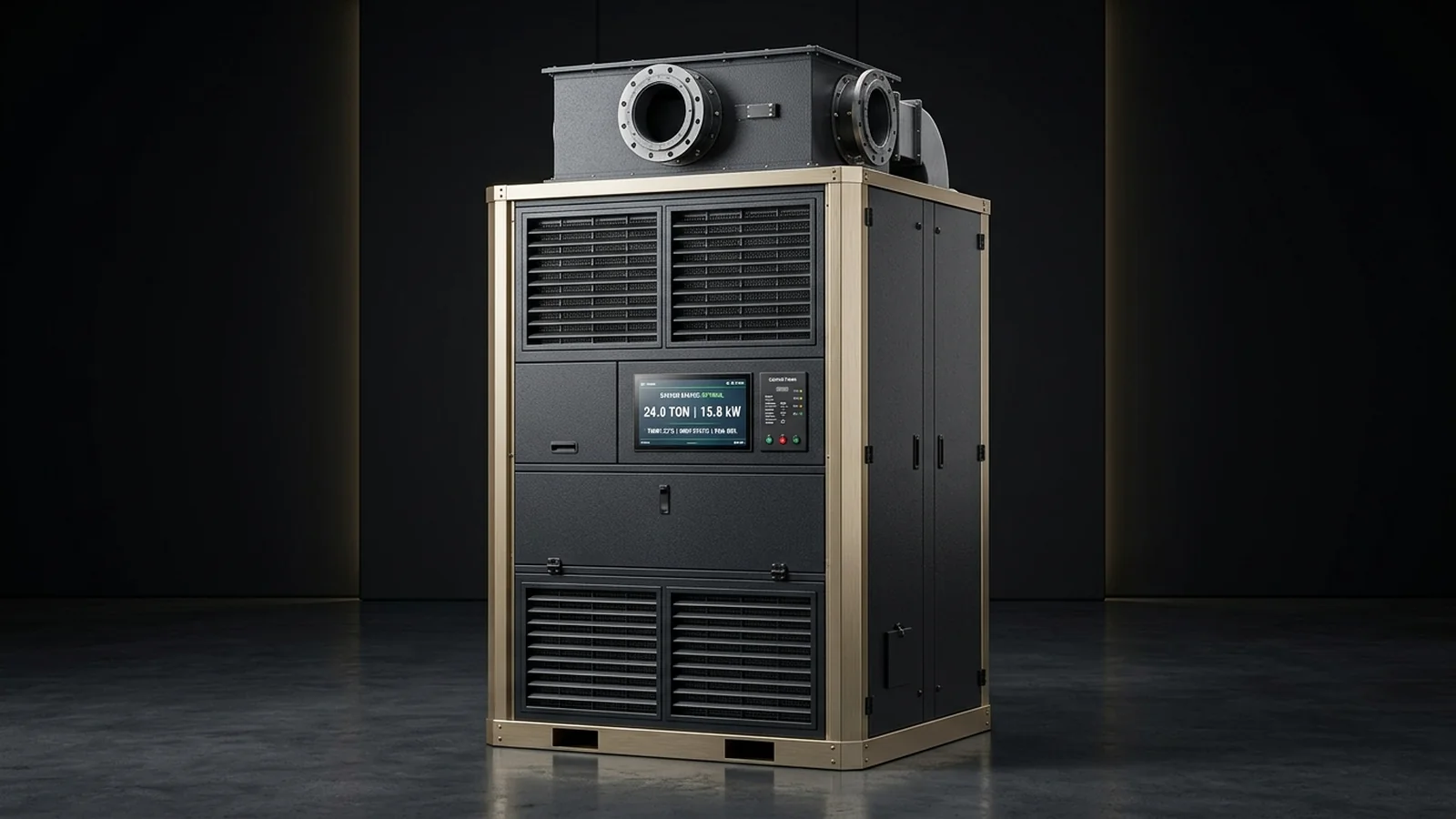
24 Ton High-Static Commercial HVAC Cabinet (FD-HVAC-024)
Engineered with 350 Pa high external static pressure blowers capable of driving conditioned air through long overhead spiral ducts and high-velocity portal air barriers across PAF maintenance bays.
Model Your Venue & Estimate HVAC Tonnage in 3D
Use the Fusion Developers interactive 3D Structure & Marquee Configurator to dimension spans from 15m to 60m, simulate guest heat loads, and compute instant multi-currency Bill of Quantities (BOQ).
Related Commercial HVAC Engineering Dossiers
PAF High-Bay Aircraft Hangar Climate Engineering
Stratification control and working-zone cooling in PAF hangars.
Spark-Free HVAC in Aviation Ordnance Zones
ATEX and Class 1 Div 2 spark-proof systems.
Thermal Pull-Down in 48°C Ambient Heat
Rapid pre-cooling engineering for large spaces.
Engineering & Procurement Inquiries
Q: How does an industrial air curtain seal a massive 30ft aircraft hangar door?
High-velocity nozzles discharge a planar air jet downward at >15 m/s angled 15° outward. This creates an aerodynamic barrier that deflects outdoor wind and pressure forces, stopping up to 80% of heat and dust infiltration.
Q: What U-value is required for aircraft maintenance hangar roofing in Pakistan?
Under ASHRAE 90.1 and defense facility engineering specs, hangar roof panels require a U-value <= 0.28 W/m²K, which is achieved using 75mm to 100mm rigid PIR (Polyisocyanurate) sandwich panels.
Q: Why is high static pressure (300+ Pa) required for hangar HVAC units?
Hangars have long clear-span distances. Delivering conditioned air from perimeter units across 35 meters requires long spiral duct runs and jet nozzles with high aerodynamic resistance, demanding minimum 300 to 350 Pa fan static pressure.
Q: How quickly can a hangar recover its setpoint after closing the mega-doors?
With high-static 24-ton cabinets delivering 9,600+ CFM and PIR insulated walls, thermal recovery time from a 5-minute door opening is reduced from over 3 hours down to under 35 minutes.
Request Stamped Psychrometric Calculations or Tender BOQ
Our senior mechanical HVAC engineers provide certified thermal heat balance assessments, electrical single-line schematics, and factory-direct equipment supply across Pakistan.
Consult Chief Engineer on WhatsApp (+92 332 2227426)