Acoustic Noise Control in Event Venues: Engineering Whisper-Quiet <55 dBA Climate Systems
High-capacity air distribution in luxury banquet spaces often produces intrusive fan roar and low-frequency compressor hum that drowns out speeches, wedding vows, and acoustic musical performances. Achieving Noise Criteria NC-35 and sound pressure levels under 55 dBA requires aerodynamic fan design, double-skin acoustic casing, and structural vibration decoupling.
1. Noise Criteria (NC-30/35) & Acoustic Baselines for Banquets
Acoustic comfort in luxury hospitality venues is defined by ASHRAE Noise Criteria (NC) curves and equivalent continuous sound pressure levels (L_Aeq). For presidential banquet halls, diplomatic convention chambers, and premium wedding marquees, the international acoustic standard specifies NC-30 to NC-35, translating to an overall sound pressure level of 48 dBA to 54 dBA across the 63 Hz to 8,000 Hz octave bands.
In contrast, substandard rental packaged units and industrial skid chillers commonly operate between 68 dBA and 74 dBA at 3 meters distance. Sound pressure decibel scales are logarithmic: an increase of 10 dBA represents a perceived doubling of subjective loudness, while an increase of 20 dBA is perceived as four times louder. A 70 dBA air conditioning roar forces guests to shout across dining tables, severely degrades speech intelligibility (STI < 0.45), and ruins professional audio recordings.
Controlling HVAC acoustic emissions requires addressing two distinct acoustic transmission pathways: airborne sound generated by high-velocity discharge air turbulence and compressor mechanics, and structure-borne vibration transmitted through equipment feet into raised plywood stages and marquee subfloors.
DECIBEL ADDITION & LOGARITHMIC SOUND FORMULA:
L_total = 10 * log10( Sum( 10^(L_i / 10) ) )
Four units operating at 52 dBA produce an aggregate room sound pressure:
L_total = 10 * log10( 4 * 10^5.2 ) = 52 + 6.02 = 58.0 dBA.
At 10 meters distance with room acoustic absorption, ambient noise drops to 51.5 dBA (NC-33).
2. Centrifugal Fan Impeller Aerodynamics (<850 RPM Design)
Aerodynamic fan noise is directly proportional to tip speed raised to the fifth power: Sound Power W_acoustic proportional to (D_tip)^2 * (V_tip)^5. High-speed fans rotating at 1,450 RPM generate intense vortex shedding, blade passage frequency (BPF) tones, and high-frequency turbulence.
Fusion Developers cabinets employ double-inlet, double-width (DIDW) forward-curved and backward-inclined centrifugal impellers dynamically balanced to ISO 1940 Grade G2.5 standards. By increasing the impeller diameter from 300mm to 450mm, the required air volume (4,000 to 8,000 CFM) is achieved at an operating speed below 850 RPM. This reductions in rotational tip speed eliminates aerodynamic whistle and lowers overall fan sound power by over 14 dB.
The blower scroll housing features an aerodynamically contoured cutoff tongue with an expanded diffusion throat that prevents high-velocity air shear at the discharge flange, ensuring laminar air discharge into the plenum with discharge air velocity maintained below 6.5 m/s (1,280 FPM).
3. Dual-Neoprene Vibration Decoupling Mounts & Structural Resonance
Structure-borne vibration is a notorious problem in temporary marquees. When heavy compressors and rotating blowers are bolted directly to steel floor channels, vibrational energy transmits through the framework into plywood deck panels. The large floor panels act as giant acoustic soundboards, amplifying 50 Hz electrical hum and 25 Hz mechanical harmonics across the entire venue.
To eliminate structure-borne transmission, all internal rotating equipment in Fusion Developers cabinets is isolated using a dual-stage decoupling system. Copeland scroll compressors are mounted on heavy-duty conical rubber-in-shear mounts possessing a static deflection of 8mm to 12mm, achieving a vibration isolation efficiency greater than 96% at 50 Hz running frequency.
In addition, the entire blower assembly is mounted on an internal floating sub-chassis decoupled from the main external cabinet by high-deflection neoprene isolators. Flexible canvas/silicone fire-retardant collars bridge the gap between the fan outlet and the exterior discharge grille, preventing any mechanical vibration from reaching the outer sheet metal skin.
4. Sound Attenuation Baffles & Double-Skin Acoustic PUF Casing
The external casing of the HVAC cabinet plays a pivotal role in acoustic containment. Standard single-skin sheet metal casings (0.8mm to 1.0mm GI) suffer from panel drum resonance and transmit internal compressor motor whine unimpeded.
Fusion Developers units utilize a rigid 25mm double-skin casing construction consisting of 0.8mm pre-painted galvanized steel outer skin, a 25mm high-density injected polyurethane foam (PUF) insulation core (density 42 kg/m³), and a 0.8mm perforated inner steel liner. The acoustic core provides a Sound Transmission Class (STC) rating of 32 dB, absorbing high-frequency mechanical noise before it can radiate outward.
For ultra-demanding acoustic environments (such as VIP bridal head-table zones), an optional internal discharge silencer baffle lined with 50mm non-fibrous acoustic foam is integrated into the top discharge hood. This attenuates airborne noise by an additional 4 to 6 dBA across the speech frequencies (500 Hz to 2,000 Hz) without imposing excessive static pressure penalties.
5. Decibel Mapping Across 15,000 Sq Ft Marquee Floors
Acoustic spatial layout is critical when positioning floor-standing cabinets. Sound waves follow inverse-square propagation laws in free fields: L_p2 = L_p1 - 20 * log10(r2 / r1). In an enclosed marquee, sound levels stabilize into a direct field near the unit and a reverberant field throughout the broader hall.
Acoustic mapping simulations demonstrate that placing four 20-ton cabinets at the four far corners of a 100ft x 150ft (15,000 sq ft) marquee directs high-velocity air along perimeter walls while maintaining sound pressure levels below 51 dBA at the central guest seating areas and VIP family stage.
Cabinets should never be positioned adjacent to public address (PA) microphone podiums or video recording control desks. By maintaining a minimum 6-meter separation between the nearest guest table and the return-air intake grille, background ambient noise comfortably achieves NC-35, enabling effortless conversation and pristine crystal-clear audio during wedding speeches.
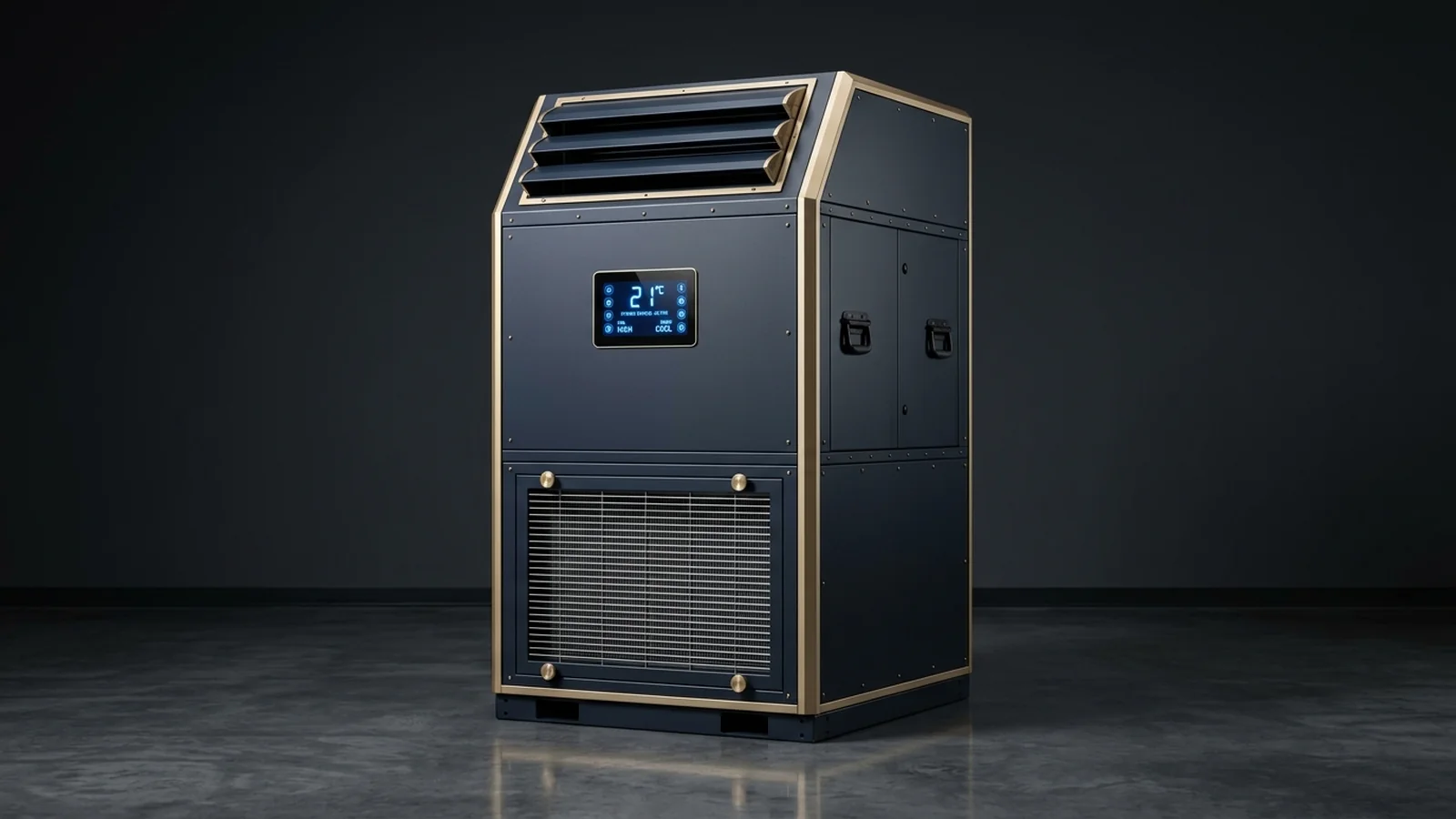
10 Ton Commercial Floor-Standing HVAC Cabinet (FD-HVAC-010)
Ultra-quiet commercial floor cabinet operating at <52 dBA, featuring 25mm double-skin PUF acoustic casing, low-RPM forward-curved DIDW centrifugal blowers, and spring-mounted Copeland Scroll compressor.
Model Your Venue & Estimate HVAC Tonnage in 3D
Use the Fusion Developers interactive 3D Structure & Marquee Configurator to dimension spans from 15m to 60m, simulate guest heat loads, and compute instant multi-currency Bill of Quantities (BOQ).
Related Commercial HVAC Engineering Dossiers
Marquee Tonnage Sizing: Sq Ft & Guest Count
Determine CFM and equipment requirements.
Islamabad & Rawalpindi Wedding Hall HVAC Guide
Strict noise containment near Potohar residential zones.
Judicial Complex Courtroom HVAC Engineering
NC-30 ultra-quiet acoustic standards for judicial chambers.
Engineering & Procurement Inquiries
Q: What is the acceptable noise level (dBA) for luxury banquet and wedding halls?
International hospitality engineering standards specify Noise Criteria NC-30 to NC-35, which corresponds to sound pressure levels of 48 dBA to 54 dBA. This ensures conversational speech privacy without intrusive equipment hum.
Q: How do low-RPM centrifugal blowers reduce air conditioning noise?
Aerodynamic fan noise is proportional to tip speed to the fifth power. By using larger-diameter 450mm impellers running at <850 RPM instead of 1,450 RPM, tip speed drops dramatically, lowering acoustic sound emissions by more than 14 dB.
Q: Why does floor vibration occur in temporary marquee air conditioning?
When compressors and fans are rigidly bolted to marquee flooring, mechanical vibration travels through the steel framing into the plywood floorboards, which act as acoustic loudspeakers. High-deflection neoprene isolators eliminate 96% of this vibration.
Q: What is double-skin PUF acoustic casing in commercial HVAC cabinets?
Double-skin casing sandwiches a 25mm dense polyurethane foam (PUF) thermal and acoustic core between two sheets of galvanized steel. This provides an STC-32 sound transmission rating, attenuating compressor noise before it can escape.
Request Stamped Psychrometric Calculations or Tender BOQ
Our senior mechanical HVAC engineers provide certified thermal heat balance assessments, electrical single-line schematics, and factory-direct equipment supply across Pakistan.
Consult Chief Engineer on WhatsApp (+92 332 2227426)