Judicial Complex & Courtroom Climate Engineering: Acoustic Speech Clarity & Zoned Bench Ventilation
High Court benches, district judicial complexes, and high-capacity constitutional courtrooms host sensitive legal proceedings where audible testimony, dignified judicial decorum, and strict speech privacy are vital. Achieving acoustic criteria below 48 dBA (NC-28) alongside dynamic occupancy management demands specialized climate engineering.
1. Dual Operational Dynamic: Packed Courtrooms vs Quiet Deliberation
Judicial courtrooms operate under extreme, polarizing operational dynamics. During high-profile constitutional hearings, criminal trials, or bail proceedings, a courtroom designed for 80 people packs with over 350 advocates, litigants, law enforcement officers, and media correspondents. Occupants crowd tightly into public benches and aisleways, releasing intense metabolic heat and moisture.
Conversely, during afternoon judicial research, chamber conferences, or reserved judgment drafting, the courtroom empties to just the presiding judge, court stenographer, and reader (3 to 5 occupants).
A fixed-capacity HVAC system fails in both scenarios: it is overwhelmed during crowded morning hearings (causing hot, stuffy air that frays tempers), and violently overcools during quiet afternoon sessions (freezing the judicial bench and cycling compressors rapidly). Multi-stage compressor modulation and precision thermostatic zoning are mandatory.
OCCUPANCY VARIABILITY LOAD RATIO:
- Peak Morning Hearing Load: 350 occupants * 450 BTU/hr = 157,500 BTU/hr (13.1 TR load)
- Quiet Afternoon Session Load: 5 occupants * 400 BTU/hr = 2,000 BTU/hr (0.17 TR load)
Turndown ratio requirement: >10:1 capacity modulation achieved via dual-circuit staging & VAV dampers.
2. Strict Judicial Acoustic Criteria (<48 dBA / NC-28 to NC-30 Speech Privacy)
In judicial proceedings, every spoken word holds profound legal weight. Witnesses speaking softly from the witness box, whispered sidebar conferences between counsel and bench, and verbatim stenographer transcription require an immaculate acoustic soundscape.
Courtroom acoustic specifications mandate background mechanical noise levels not exceeding NC-28 to NC-30 (sound pressure <= 45 to 48 dBA). Mechanical equipment hum, blower motor vibration, and duct air turbulence must never mask the voice of a frail witness or delicate testimony.
Fusion Developers judicial cabinets achieve these rigorous acoustic targets by deploying double-width forward-curved blowers running at ultra-low tip speeds (<700 RPM), internal aerodynamic sound absorption baffles lined with acoustic foam, and spring-isolated compressor sub-chassis that prevent mechanical vibrations from transmitting into courtroom walls and raised timber judicial dais platforms.
3. Zoned Air Delivery: Judicial Bench vs Bar Rostrum vs Litigant Gallery
A formal courtroom is divided into distinct functional zones with contrasting clothing and physical conditions: The elevated Judicial Bench (judges wearing heavy formal woolen gowns and coats), the Bar Rostrum (advocates in black blazers and waistcoats), and the Litigant Public Gallery (casual high-density crowds).
Under traditional single-zone air conditioning, judges wearing heavy judicial robes feel uncomfortably hot while litigants in thin shirts freeze. Zoned Air Distribution resolves this conflict.
Conditioned air is segregated into three independent thermal zones: Zone 1 delivers dedicated low-velocity cool air (20.5°C) directly around the judicial bench and witness stand. Zone 2 conditions the advocate bar rostrum at 22.0°C, and Zone 3 modulates high-volume fresh air across the public gallery based on real-time CO2 and occupancy load.
Independent wall-mounted digital thermostats allow judicial staff to adjust bench temperatures directly without disrupting overall courtroom comfort.
4. CO2-Driven Demand-Controlled Ventilation Preventing Cognitive Fatigue
Courtrooms are notorious for becoming stuffy and sleep-inducing during extended afternoon legal arguments. When 250 people occupy an enclosed hall with insufficient fresh air ventilation, Carbon Dioxide (CO2) concentrations rapidly climb from outdoor ambient levels (420 ppm) to over 2,200 ppm within 90 minutes.
Extensive scientific research confirms that indoor CO2 levels above 1,200 ppm induce cognitive fatigue, reduced decision-making speed, headaches, and drowsiness—severe impediments to justice during complex legal analysis.
Our judicial systems incorporate precision Non-Dispersive Infrared (NDIR) CO2 sensors linked directly to modulating outdoor fresh air dampers. When CO2 levels exceed 800 ppm, the system automatically introduces up to 20 CFM per person of filtered, conditioned outdoor air, purging stale air and maintaining sharp judicial alertness throughout multi-hour proceedings.
5. Discrete Architectural Cabinet Integration in Heritage & Modern Courts
Judicial buildings range from historic colonial-era High Court structures (such as the Lahore High Court with carved teak woodwork and high brick arches) to sleek contemporary district judicial complexes.
Exposed industrial air conditioners, unsightly surface-mounted conduits, and plastic split units violate judicial dignity and heritage preservation guidelines. Fusion Developers cabinets feature discrete architectural integration options.
Cabinets can be custom-clad with acoustic hardwood louvers matching historic courtroom walnut or teak paneling, or recessed into discrete perimeter millwork alcoves. Return air enters through low-profile architectural grilles, while supply air feeds through discrete high-level linear slot diffusers integrated into ceiling molding, preserving the solemn majesty of the courtroom.
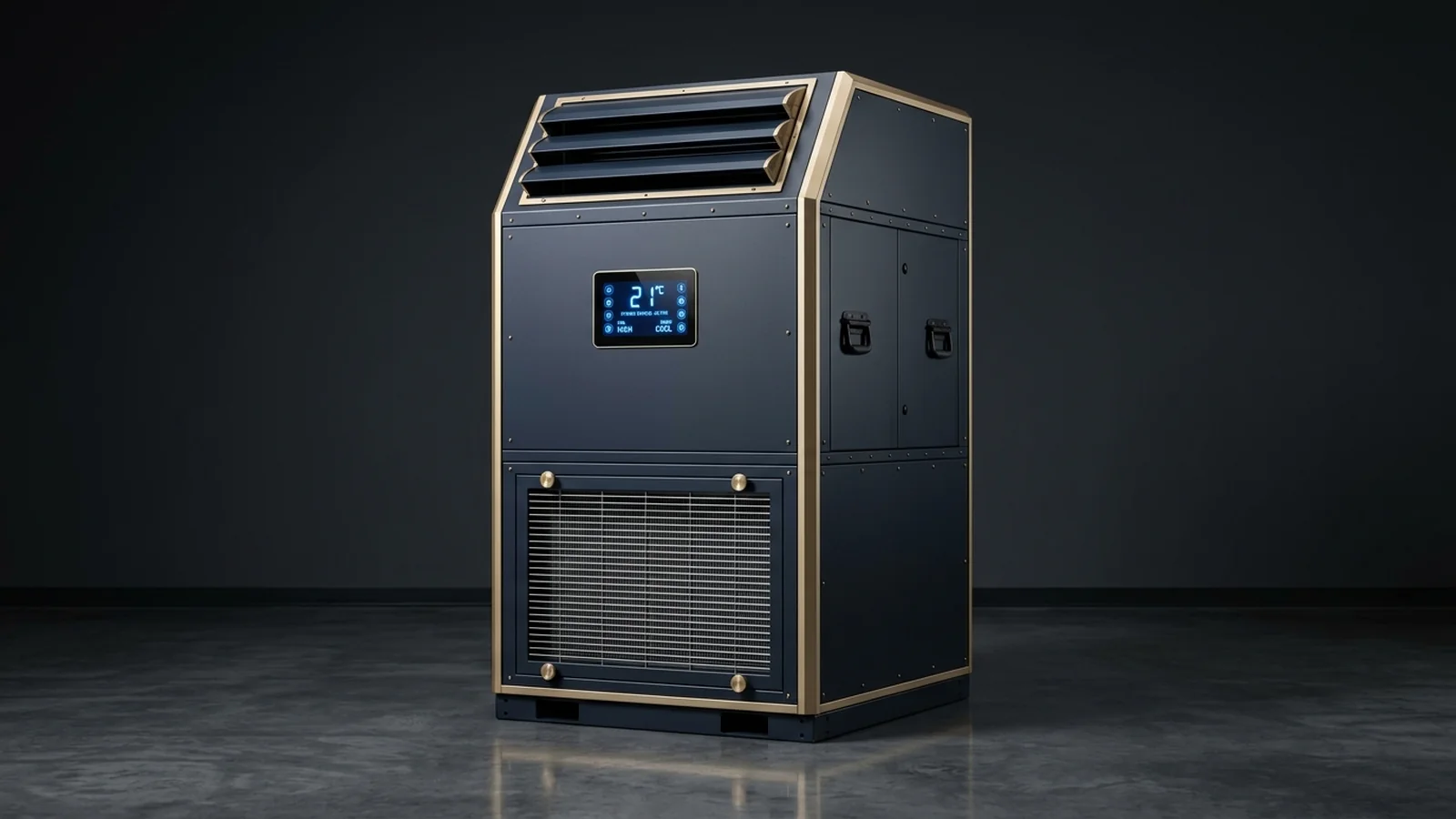
10 Ton Commercial Floor-Standing HVAC Cabinet (FD-HVAC-010)
Ultra-quiet commercial floor unit operating at <50 dBA, featuring double-skin acoustic PUF insulation, low-RPM aerodynamic blowers, and discrete architectural wooden panel integration for historic and modern courtrooms.
Model Your Venue & Estimate HVAC Tonnage in 3D
Use the Fusion Developers interactive 3D Structure & Marquee Configurator to dimension spans from 15m to 60m, simulate guest heat loads, and compute instant multi-currency Bill of Quantities (BOQ).
Related Commercial HVAC Engineering Dossiers
Secretariat Convention Hall HVAC Systems
Diplomatic IEQ and low-noise government convention cooling.
Acoustic Noise Control (<55 dBA) for Events
Blower impeller aerodynamics and vibration isolation.
PPRA & PEC Compliant HVAC Tender BOQs
Bidding documents and technical matrices for public buildings.
Engineering & Procurement Inquiries
Q: What acoustic noise level is required inside judicial courtrooms?
Courtrooms require Noise Criteria NC-28 to NC-30 (sound levels below 48 dBA). This ensures clear speech intelligibility for quiet witness testimony and stenographic recording without background HVAC hum.
Q: How does zoned air distribution prevent judges in heavy robes from overheating?
Air delivery is divided into independent thermal zones: a dedicated low-velocity cooling zone keeps the judicial bench at 20.5°C to compensate for heavy robes, while the public gallery is maintained at 23°C.
Q: Why is CO2 monitoring critical in packed courtrooms?
Crowded courtrooms quickly accumulate CO2 above 2,000 ppm, causing drowsiness and headaches. Demand-controlled ventilation introduces filtered fresh air whenever CO2 exceeds 800 ppm, maintaining mental alertness.
Q: Can commercial HVAC cabinets be integrated into heritage wooden courtrooms?
Yes. Cabinets can be custom-paneled with matching architectural teak or walnut louvers and recessed into perimeter alcoves, providing high-capacity cooling while preserving judicial heritage aesthetics.
Request Stamped Psychrometric Calculations or Tender BOQ
Our senior mechanical HVAC engineers provide certified thermal heat balance assessments, electrical single-line schematics, and factory-direct equipment supply across Pakistan.
Consult Chief Engineer on WhatsApp (+92 332 2227426)