24/7 Military Command & Strategic Communications Post Climate Engineering
Tactical Operations Centers (TOC), C4ISR complexes, and underground military communications posts house dense high-density server racks, encrypted satellite relays, and critical command staff. Climate systems must guarantee non-stop 24/7 operation under intense thermal loads, electronic warfare threats, and zero tolerance for thermal downtime.
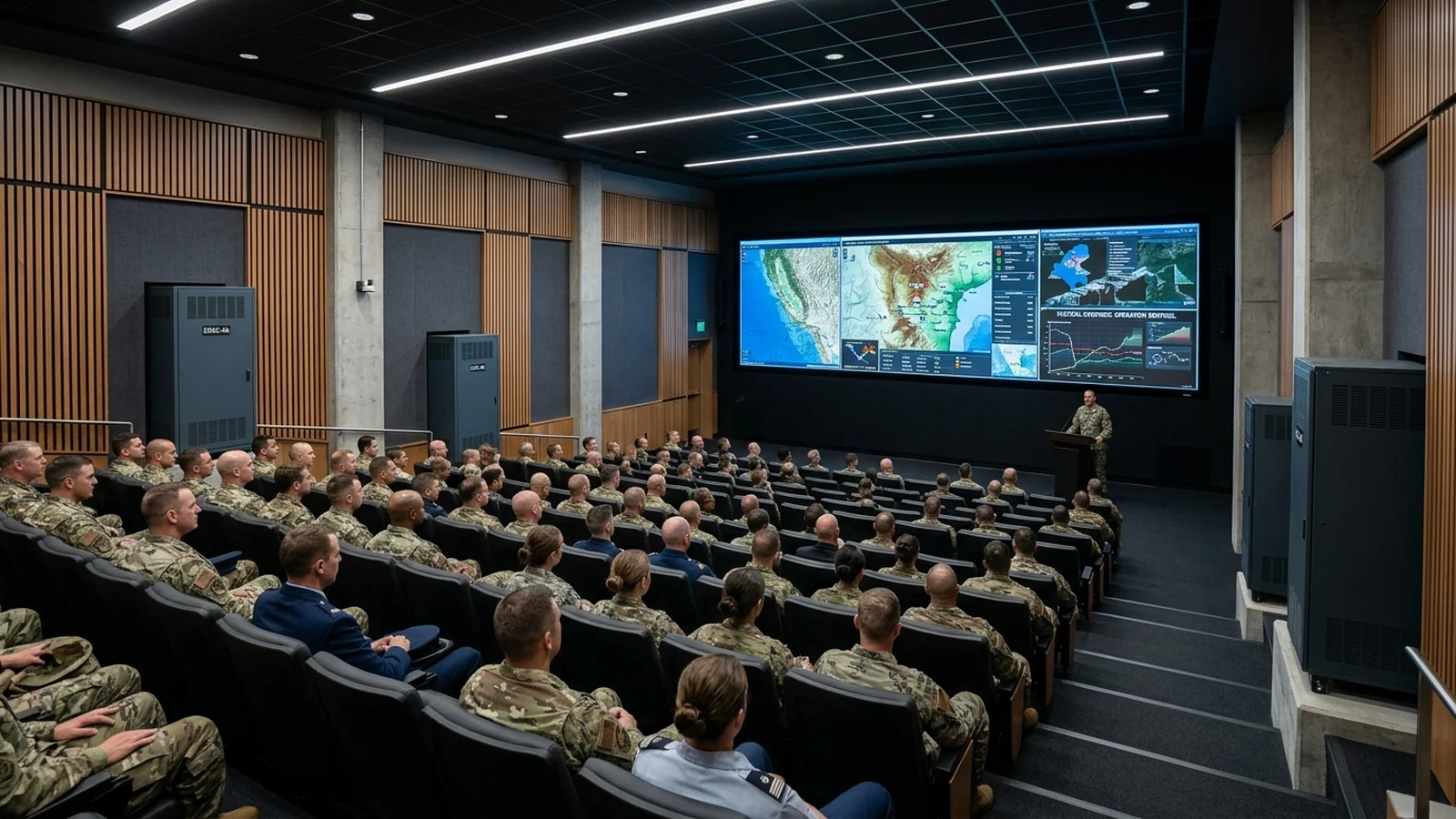
1. Operational Criticality of Tactical Operations Centers (TOC) & C4ISR Rooms
Military Command, Control, Communications, Computers, Intelligence, Surveillance, and Reconnaissance (C4ISR) command hubs serve as the nerve centers for modern armed forces operations. Inside reinforced bunker structures or modular tactical shelters, dense clusters of blade servers, encrypted tactical radios, multi-screen command video walls, and satellite transceivers dissipate intense, continuous heat.
Unlike standard office spaces, the heat load inside a command post is overwhelmingly sensible (Sensible Heat Ratio SHR > 0.88 to 0.92), generated 24 hours a day, 365 days a year. A thermal failure that elevates ambient room temperature above 32°C (89.6°F) triggers thermal throttling in mission-critical servers, degrades signal-to-noise ratios in RF communication transceivers, and can cause catastrophic computing shutdown during active combat operations.
Military engineering doctrine mandates that HVAC infrastructure serving strategic command centers be classified as 'Category 1 Mission-Critical Life-Support Equipment,' requiring fail-safe dual-circuit redundancy, electromagnetic compatibility, and hardened environmental ingress protection.
SENSIBLE HEAT DOMINANCE FORMULA:
SHR = Q_sensible / (Q_sensible + Q_latent)
In a command center with 45 kW of blade servers (153,500 BTU/hr sensible) and 20 staff,
Total sensible load = 162,000 BTU/hr, Latent load = 4,000 BTU/hr -> SHR = 0.975.
Evaporator airflow must be sized for high sensible capacity (>450 CFM/TR) at low latent extraction.
2. Dual-Circuit N+1 Redundant Refrigeration Architecture
To achieve military operational availability targets (A_o > 99.98%), single-compressor commercial HVAC units are strictly prohibited in strategic command facilities. A single mechanical fault—such as an electrical motor winding burnout or a refrigeration capillary leak—instantly downs the entire climate control system.
Fusion Developers FD-HVAC-020 cabinets are constructed with completely isolated Dual Refrigeration Circuits (Circuit A and Circuit B). Each circuit features its own dedicated Copeland hermetic scroll compressor, independent liquid line filter-drier, sight glass, thermostatic expansion valve, evaporator coil section, and condenser coil bank.
If Circuit A experiences a mechanical interruption or is taken offline for scheduled refrigerant oil sampling, Circuit B continues operating autonomously, providing 120,000 BTU/hr (50% base capacity) to prevent dangerous thermal runaway. When deployed in pairs (two 20-ton cabinets serving a 20-ton room load), the facility achieves true N+1 redundant fault tolerance.
3. High Sensible Heat Ratio (SHR > 0.88) for Server & Radio Racks
Standard comfort air conditioning systems are designed with a low Sensible Heat Ratio (SHR 0.65 to 0.72) intended to extract substantial moisture from sweaty human occupants. In a dry command server room, applying a low-SHR comfort AC causes excessive dehumidification, driving indoor relative humidity below 30% RH.
Excessively low humidity creates a severe hazard: Electrostatic Discharge (ESD). Static charges accumulating on personnel walking across raised floor tiles can deliver 15,000V micro-arcs when touching communications hardware, permanently frying sensitive microprocessors.
Fusion Developers military cabinets are specifically tuned for high-sensible heat performance (SHR 0.88 to 0.92). Evaporator coils operate with elevated refrigerant evaporating temperatures (7.5°C to 9.0°C) and expanded volumetric airflow rates (450 to 500 CFM per ton). This delivers rapid sensible heat extraction while leaving airborne moisture intact, stabilizing space humidity within the safe 45% to 55% RH window required by MIL-STD-1472.
4. EMI/RFI Shielding & Surge Suppression on Control Circuits
Strategic communications posts operate in dense electromagnetic environments surrounded by high-power VHF/UHF transmitters, radar emissions, and potential enemy electronic jamming. Furthermore, military facilities must guard against High-Altitude Electromagnetic Pulse (HEMP) weapons and TEMPEST eavesdropping eavesdroppers.
Standard plastic HVAC digital thermostats and unshielded microcontroller boards act as unintended antennas, receiving radio frequency interference (RFI) that corrupts sensor inputs and causes erratic temperature cycling. Conversely, unshielded variable-speed blower drives emit high-frequency electromagnetic noise that interferes with sensitive radio reception.
Fusion Developers military command cabinets integrate comprehensive EMI/RFI shielding under MIL-STD-461G standards. Electrical control modules are housed inside seam-welded 2.0mm galvanized steel NEMA 4 enclosures lined with beryllium-copper RF finger gaskets. All incoming power and communication leads pass through transient voltage surge suppressors (TVSS / Type 1 SPD) and high-attenuation feedthrough Pi-filters, attenuating RF emissions by over 60 dB from 10 kHz to 1 GHz.
5. Hardened Ingress Protection (IP55) & Blast Overpressure Dampers
Bunkered strategic command centers are subjected to severe external environmental threats—including weapons blast overpressure waves, ground shock vibration from artillery concussions, and chemical/biological/radiological (CBRN) aerosols.
Air intake ducts penetrating hardened bunker walls must be equipped with heavy-duty mechanical Blast Overpressure Dampers engineered to withstand dynamic blast shockwaves up to 3.0 bar (43.5 psi). The spring-loaded blast vanes snap closed within 15 milliseconds of an explosive overpressure wave, isolating the internal HVAC ductwork from blast destruction before automatically resetting.
The floor cabinets themselves feature IP55 environmental ingress protection across all electrical bays, protecting terminal blocks from dust ingress and water spray. Structural frames are fabricated from 2.5mm cold-formed steel channels anchored to the floor slab via high-deflection seismic snubbers and elastomeric isolators qualified to endure ground accelerations up to 1.5g.
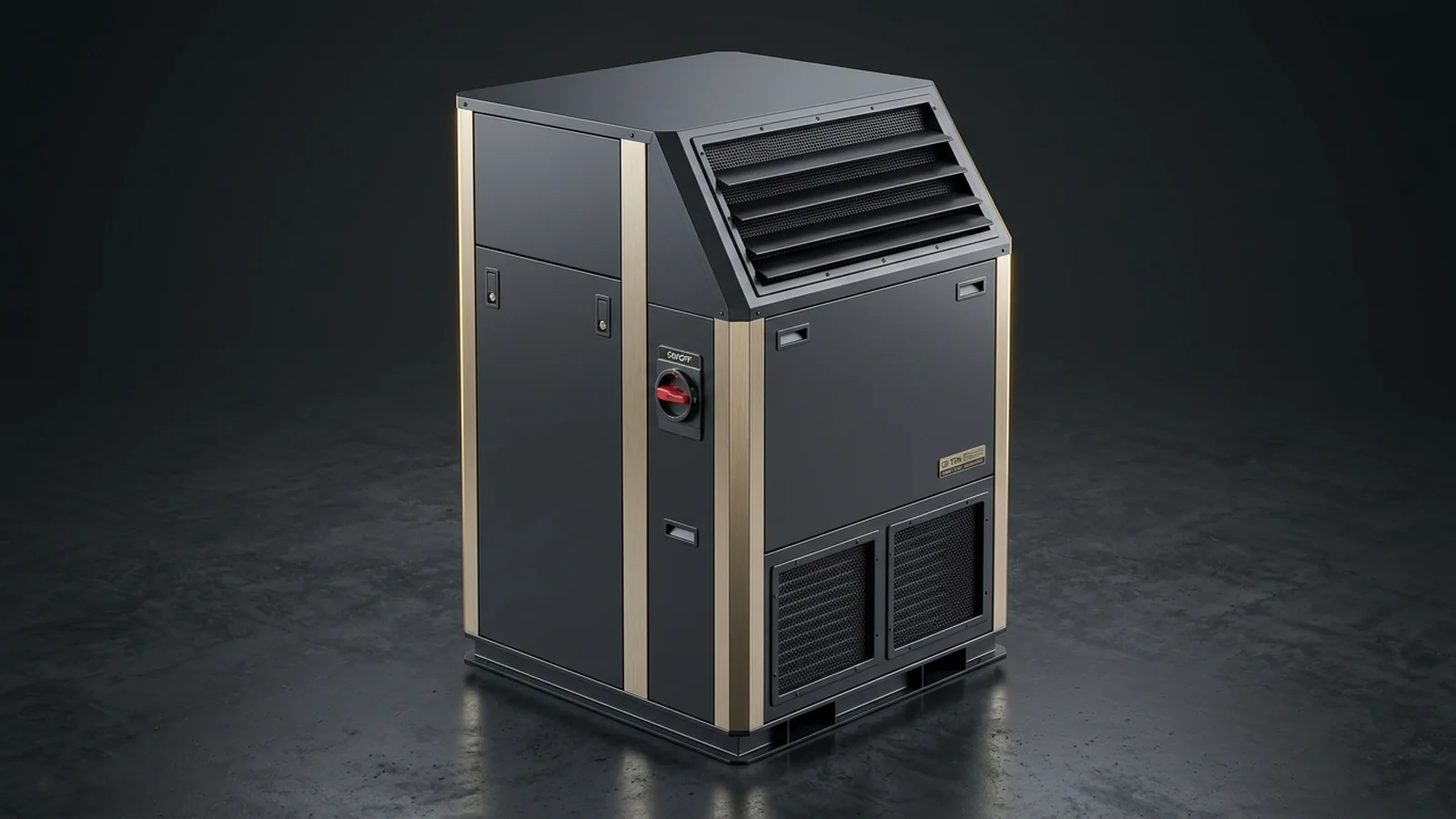
20 Ton Commercial Floor-Standing HVAC Cabinet (FD-HVAC-020)
Engineered with dual isolated refrigeration circuits and dual Copeland scroll compressors, ensuring 50% backup cooling capacity during single-circuit maintenance without breaking operational continuity.
Model Your Venue & Estimate HVAC Tonnage in 3D
Use the Fusion Developers interactive 3D Structure & Marquee Configurator to dimension spans from 15m to 60m, simulate guest heat loads, and compute instant multi-currency Bill of Quantities (BOQ).
Related Commercial HVAC Engineering Dossiers
Rapid-Deploy Containerized Tactical HQ HVAC
Skid-mounted climate systems for mobile field command.
Defense Procurement Life-Cycle Costing & Maintenance
MES procurement standards, MTBF, and depot spares.
Desert-Rated T3 Heavy Sand Filtration
Ruggedized 52°C cooling for border base outposts.
Engineering & Procurement Inquiries
Q: Why is dual-circuit redundancy essential in military command post HVAC?
A command post cannot afford thermal downtime. Dual independent refrigeration circuits ensure that if one compressor or refrigerant line fails, the second circuit continues cooling at 50% capacity, maintaining server and communications operations.
Q: What is Sensible Heat Ratio (SHR) and why must it be high in C4ISR facilities?
SHR is the ratio of sensible (temperature) cooling to total cooling. Command facilities have immense heat from electronic servers but very little human moisture. A high SHR (>0.88) cools the servers without overdrying the room, preventing damaging electrostatic discharge (ESD).
Q: How does EMI/RFI shielding protect military HVAC systems?
High-power military transmitters and radar emit intense radio waves. EMI-shielded metal enclosures and power-line filters prevent these signals from interfering with HVAC microprocessors, while also stopping the HVAC unit from emitting noise into military radios.
Q: What are blast overpressure dampers in bunkered military HVAC?
Blast dampers are heavy-duty mechanical valves placed in duct wall penetrations. In the event of a nearby explosion, the shockwave snaps the dampers shut in 15 milliseconds, protecting the HVAC unit and bunker occupants from blast overpressure.
Request Stamped Psychrometric Calculations or Tender BOQ
Our senior mechanical HVAC engineers provide certified thermal heat balance assessments, electrical single-line schematics, and factory-direct equipment supply across Pakistan.
Consult Chief Engineer on WhatsApp (+92 332 2227426)