Inverter Efficiency & Life-Cycle Energy Savings: Sashing Utility Bills in Public Buildings
Commercial electricity tariffs in Pakistan have escalated past PKR 68/kWh, with severe Maximum Demand Indicator (MDI) fixed charges. Public sector buildings, university campuses, and municipal secretariats spend over 65% of their utility budgets on air conditioning. Transitioning to full DC Inverter commercial floor cabinets reduces electrical consumption by 32% to 45% through part-load optimization.
1. Part-Load Operational Reality of Public Buildings (50% to 75% Load)
A critical engineering flaw in legacy public building HVAC sizing is assuming equipment operates at 100% full capacity around the clock. In reality, outdoor weather and indoor occupancy are constantly changing.
According to ASHRAE 90.1 weather bin data for Lahore and Islamabad, commercial buildings operate at 100% full design load for less than 3% to 5% of total annual cooling hours. For over 85% of their operating lifetime, buildings operate at Part-Load conditions (between 40% and 75% of full rated capacity)—during mild mornings, cloud cover, and partial office occupancy.
Fixed-speed compressors operate in a binary state: running at 100% speed or cycling completely off. During part-load periods, fixed-speed compressors cycle on and off frequently, causing massive electrical inrush spikes, mechanical wear, and severe thermodynamic efficiency losses.
AHRI INTEGRATED PART-LOAD VALUE (IPLV) FORMULA:
IPLV = 0.01*A + 0.42*B + 0.45*C + 0.12*D
Where A = EER at 100% load (1% weighting), B = EER at 75% load (42% weighting),
C = EER at 50% load (45% weighting), D = EER at 25% load (12% weighting).
Part-load efficiency (B & C) accounts for 87% of real-world energy consumption!
2. DC Inverter vs Fixed-Speed Compressors: IPLV & SEER Metrics
Direct Current (DC) Inverter compressors utilize brushless permanent magnet (BLDC) motors driven by variable frequency electronic inverters. By modulating motor electrical frequency (from 15 Hz to 90 Hz), the compressor dynamically adjusts refrigerant mass flow to match instantaneous room cooling demand in real time.
When room cooling load drops to 50%, an inverter compressor modulates down to 50% speed. Because heat exchanger surfaces (evaporator and condenser coils) are now effectively oversized relative to the reduced refrigerant flow, evaporating temperatures rise and condensing temperatures drop.
This dramatic reduction in compressor pressure ratio slashes compressor power draw by more than 58% at half load (affinity law power P proportional to N^2.8). Consequently, while a fixed-speed unit exhibits an IPLV of 11.2 BTU/Wh, a modern DC Inverter cabinet achieves an IPLV exceeding 18.5 BTU/Wh—an efficiency leap of over 65%.
3. Financial Payback Modeling under Escalating Commercial Power Tariffs
Under NEPRA-approved commercial utility tariffs (LESCO, IESCO, K-Electric Tariff A-2 and B-2 Commercial), electricity costs exceed PKR 68 per kWh during off-peak hours and PKR 82 per kWh during peak evening hours, inclusive of fuel price adjustments (FPA), quarterly tariff adjustments (QTA), and government surcharges.
Financial Analysis for a 10-Ton Floor Cabinet (Running 3,000 Hours/Year): A standard fixed-speed 10-ton unit (EER 10.2) draws an average of 11.8 kW, consuming 35,400 kWh annually. At PKR 70/kWh, annual electricity cost is PKR 2,478,000 (USD $8,880).
A DC Inverter 10-ton cabinet (IPLV 17.5) draws an average part-load power of only 7.1 kW, consuming 21,300 kWh annually. Annual electricity cost is PKR 1,491,000 (USD $5,340). Annual direct energy savings total PKR 987,000 (USD $3,540) per unit every year.
With an incremental capital cost premium of approximately PKR 320,000 for the DC inverter model, the financial payback period is just 3.9 months. Over a 10-year service life, net savings exceed PKR 9.87 million per cabinet.
4. 10-Year Cumulative Operational Cash Flow & Break-Even Timeline
For a medium-sized public secretariat or university faculty building utilizing ten 10-ton commercial cabinets (100 Tons total cooling plant), cumulative financial savings scale exponentially.
Fleet Financial Modeling: Fleet initial equipment cost premium is PKR 3.2 million. Annual fleet electricity savings total PKR 9.87 million. Cumulative 10-year undiscounted power bill savings reach PKR 98.7 million (USD $353,000).
Accounting for an annual 8% compound increase in Pakistan's energy tariffs, cumulative 10-year operational savings surpass PKR 142 million. The break-even timeline is achieved in the first summer of operation, freeing up substantial municipal operating budgets for core educational and administrative public services.
5. NEECA Compliance, Power Factor Correction (>0.95), and Carbon Cuts
Pakistan's National Energy Efficiency and Conservation Authority (NEECA) under the Ministry of Energy mandates that public buildings comply with national energy conservation codes, targeting minimum 3-Star and 4-Star energy appliance standards.
Traditional fixed-speed induction motors exhibit poor electrical power factors (PF = 0.75 to 0.82) at partial loads, drawing heavy reactive kVA current that triggers severe utility low-power-factor surcharges. Fusion Developers inverter units incorporate active Power Factor Correction (PFC) circuitry on their DC bus, maintaining a true power factor greater than 0.96 across all operating speeds.
Environmentally, saving 141,000 kWh annually across a 10-cabinet public installation prevents the emission of over 72 metric tons of Carbon Dioxide (CO2) annually from fossil-fuel power grids, directly supporting Pakistan's international Nationally Determined Contributions (NDC) climate goals.
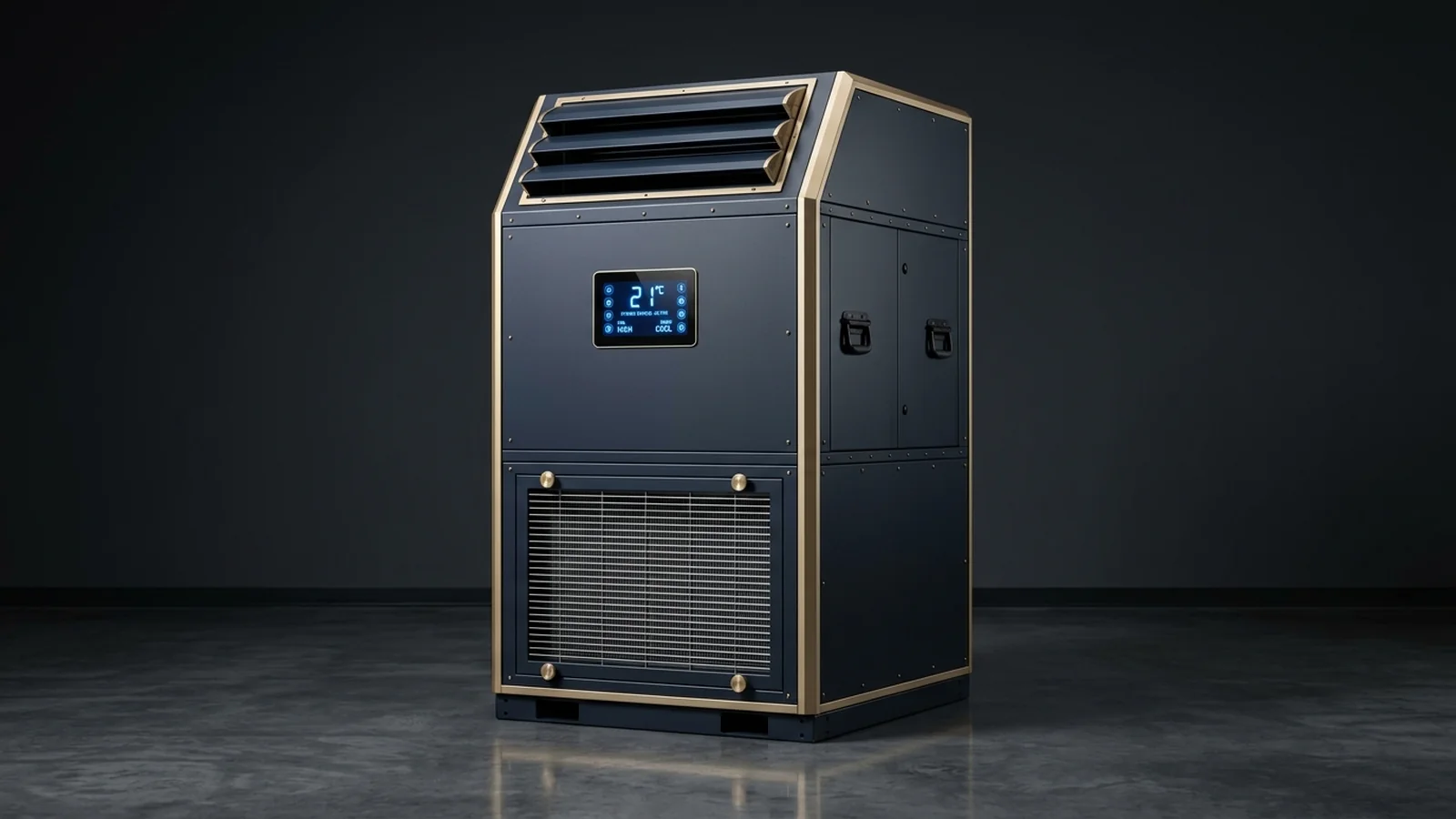
10 Ton Commercial Floor-Standing HVAC Cabinet (FD-HVAC-010)
Full DC Inverter commercial floor cabinet achieving an exceptional Integrated Part-Load Value (IPLV 18.2 BTU/Wh) and power factor >0.96, saving over PKR 1.4 million annually in commercial power bills.
Model Your Venue & Estimate HVAC Tonnage in 3D
Use the Fusion Developers interactive 3D Structure & Marquee Configurator to dimension spans from 15m to 60m, simulate guest heat loads, and compute instant multi-currency Bill of Quantities (BOQ).
Related Commercial HVAC Engineering Dossiers
PPRA & PEC Compliant HVAC Tender BOQs
Standard bidding documents and technical matrices.
BACnet & Modbus BMS Integration for Government Complexes
Centralized building automation for public infrastructure.
Capex vs Rental HVAC Analysis in Pakistan
Financial modeling for commercial venue cooling.
Engineering & Procurement Inquiries
Q: What is the difference between EER and IPLV in commercial HVAC?
EER measures efficiency at 100% full capacity in 35°C heat. IPLV (Integrated Part-Load Value) measures weighted efficiency across 100%, 75%, 50%, and 25% loads, reflecting real-world operation where units run at partial load 85%+ of the time.
Q: How much electricity can DC Inverter commercial cabinets save in public buildings?
DC Inverter cabinets save 32% to 45% in electrical power compared to fixed-speed units by slowing down compressor speed during mild weather and partial building occupancy instead of cycling on and off.
Q: What is the financial payback period for choosing an inverter commercial AC in Pakistan?
With commercial electricity rates exceeding PKR 68/kWh, the initial price premium of an inverter unit is paid back through lower electricity bills in just 3.9 to 5.5 months of operational cooling.
Q: How does power factor correction (PFC) reduce electricity bills?
Power factor correction maintains an electrical power factor above 0.96. This eliminates utility low-power-factor penalty charges and reduces current draw on building transformers and generator backup systems.
Request Stamped Psychrometric Calculations or Tender BOQ
Our senior mechanical HVAC engineers provide certified thermal heat balance assessments, electrical single-line schematics, and factory-direct equipment supply across Pakistan.
Consult Chief Engineer on WhatsApp (+92 332 2227426)